
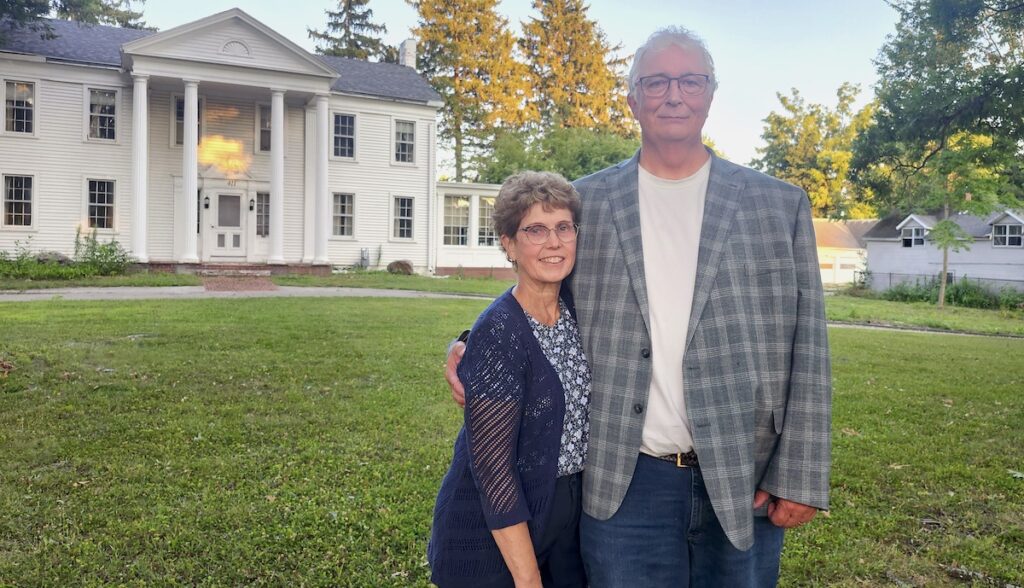
ADRIAN — The Adrian City Commission voted unanimously on Aug. 3 to sell the Fee House, a historic home at 411 S. Main St., to a local builder who proposed to restore it as a single-family residence but also make it available for public events in partnership with Hidden Lake Gardens.
The 1845 house was once the home of Harry and Harriet Fee. Harry Fee was the benefactor who helped create Hidden Lake Gardens, a botanical garden and arboretum operated by Michigan State University, and Harriett Kimball Fee created an endowment that funds the upkeep of Adrian’s parks. The house was bequeathed to the city upon the death of its most recent owner, and the city commission listed it for sale earlier this year with several conditions, including that it remain a single-family residence.
Kevon Martis of Riga operates Kevon Martis & Associates and also serves on the Lenawee County Commission. He and his wife, Karrie, offered to pay $75,000 for the house. While acknowledging that their bid was less than the original asking price of $220,000, Martis said the anticipated cost of renovations made offering $220,000 impossible. He also said he would make the house and grounds available for public programming and make a legally binding commitment to provide for its future upkeep.
“Not only have I offered $75,000 cash for the property, my offer also includes a commitment to put $200,000 upon our deaths into an investment with the Lenawee Community Foundation to care for the property into the future,” Martis told the city commission.
In addition, Hidden Lake Gardens will have a permanent right of first refusal to acquire the house in the event that the Martises’ heirs do not want to continue as its owners.
The commission chose Martis’ proposal over two others.
One of the other bidders, Daniel Demlow of Saline, proposed to turn the house into a bed-and-breakfast. Demlow also spoke at the commission meeting, saying his family has deep roots in Lenawee County and that he is a graduate of Sand Creek High School. He told the commission he is the general manager of a robotics and automation company in Saline.
“My vision is to restore the Fee House to its historic beauty and operate a boutique bed-and-breakfast that attracts visitors to Adrian,” Demlow said. “I plan to partner with local restaurants, businesses, and attractions to create destination experiences that encourage guests to spend time and money throughout our community.”
Demlow offered $50,000, with a note that he was willing to pay $5,000 over any other comparable offer, up to a maximum of $160,000. His proposal also asked the city to consider a five-year tax deferral and to commit to not reassessing the property’s value during the first 10 years.
A third proposal was for $20,000 and was submitted by Soprinye T. Dappa of Denver, Colorado.
Martis submitted several letters of support for his plan. Paul Pfeifer, managing director of Hidden Lake Gardens, wrote that he anticipates many opportunities to partner with the Martis family. Those opportunities include developing gardens and offering educational events and community activities in the house and on its grounds. Luke Barnett, president of the Sam Beauford Woodworking Institute, talked about making the house a learning opportunity for historic preservation students. And local architect Brenda Rigdon, who also spoke at the meeting, said she was impressed with Martis’ plans for a historically faithful restoration.
“I firmly believe that Kevon and his wife Karrie will be the best stewards of this architectural treasure,” said Rigdon, who is also the former executive director of the Michigan Historic Preservation Network.
Speaking after the meeting, Martis said he views the Fee House as a second home, but also as a resource that he intends to make an active part of the community.
He said he plans to begin work as soon as possible upon completing the purchase. Although restoration will probably take three or four years, he said, there will be some dramatic changes in the first year.
The changes people will notice when they pass the house include shutters on the windows and a railing around the top of the porch on the south side of the house — features that historical photographs show the house had in the past.
Martis also said the house hasn’t undergone a major renovation since the 1930s — but that’s actually a good thing.
“When Mr. Fee redid this in the 1930s, it was done with the highest state-of-the-art technology at the time, and I’m just so pleased that nobody messed it up afterwards,” he said.
Martis said he hopes to make the house a point of community pride.
“We’ll do everything we can to make the city proud of this,” he said.