
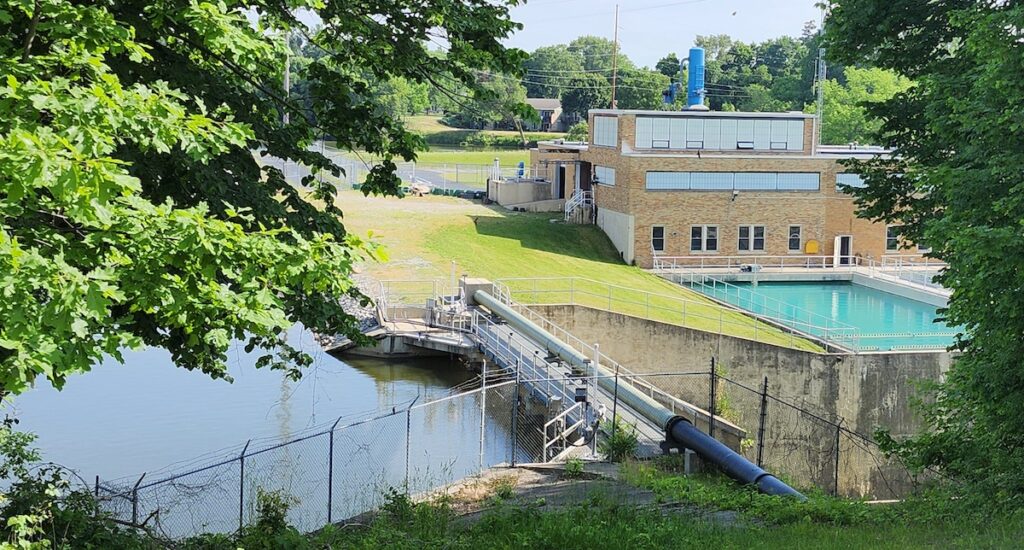
ADRIAN — A springtime spike in complaints about Adrian’s city water led to a good deal of discussion at the June 1 Adrian City Commission meeting.
City commissioners heard comments from members of the public about their problems with city water, and also received a report from utilities director and acting city administrator Will Sadler about the reasons for the problem and the challenges involved in fixing it.
“Our drinking water is an essential need,” city resident Michelle Taylor said during the public comment period. “It’s something that we trust the city of Adrian to provide. And the fact that it has horrific taste and horrific smell makes it contaminated, and it is beyond a nuisance.”
A similar sentiment came from city resident Scott Marvin, who said: “If you’re willing to fix the water problem, I’m willing to pay more for my water bill to have clean water.”
What is the cause?
Adrian gets its water from two sources. The primary source is a wellfield on Hamilton Highway, but groundwater from the four wells there gets mixed with surface water from Lake Adrian, a manmade reservoir that was created about 85 years ago by damming Wolf Creek. The water from Lake Adrian is the source of the problems, Sadler said.
“There are two main organic compounds that thrive in the lake that are the culprit in our issues,” he said.
Those compounds are 2-Methylisoborneol, often called MIB, and Geosmin. Both have a taste and smell that is often described as musty or earthy. Different people can detect these compounds at different levels, which is why some people say the water is undrinkable while others can’t taste anything at all.
Sadler said the primary compound affecting the taste and smell of Adrian’s water right now is MIB. The concentration of MIB in Lake Adrian spiked this May, just like it did last spring, but this year the levels did not come down as quickly.
“The biggest way for us to help with that is running all of our wells,” Sadler said. That’s because when groundwater makes up a larger portion of the water that comes out of people’s taps, the total concentration of MIB is diminished.
This spring, Sadler said, one of the four Hamilton Highway wells had to be taken down for maintenance while a motor and a pump were replaced. But although greater reliance on surface water exacerbates the problem, he said, some people can detect MIB and Geosmin at such low levels — 10 parts per trillion or below — that they can still taste and smell it even when all four wells are running.
“We’re still pumping about 70 percent well water, so that just goes to show you how potent this particular compound is,” he said. “Even though we’re using only 30 percent water from the lake, it’s still strong enough for people to notice.”
What can be done?
MIB and Geosmin are both notoriously difficult to remove using conventional treatment methods. Water is treated with activated carbon at the city’s plant on Bent Oak Avenue, but that isn’t able to remove more than a fraction of the total amount.
And the problem can’t be addressed by relying exclusively on groundwater, Sadler said, because the aquifers in the Adrian area just aren’t able to supply it in enough volume.
“We are groundwater-poor,” he said. “It’s just not there in the quantities that we need it. And even if you gave me an unlimited bag of money to put as many wells as I could possibly drill into that specific aquifer, I can’t pull it.”
Adding a fifth well at Hamilton Highway is still an option, Sadler said, and the city has been working with the Michigan Department of Environment, Great Lakes, and Energy to get permission for that. Although the city still would still only be able to run four wells at a time, the fifth would provide a backup.
“If we are able to put that in, that doesn’t mean we get to run five wells,” Sadler said. “That means we can still only run four, but at least we’ll have one when one of them is down for repair or for maintenance.”
If approved, a new well is probably a year to a year and a half away, Sadler said.
As for the surface water that is the source of the problem, the city currently uses ultrasonic wave generators to help control the algae that releases MIB and Geosmin. Those replaced the solar-powered circulation devices that could once be seen in the middle of Lake Adrian every summer.
Responding to a question about whether something like a reverse osmosis system would work, Sadler said those systems bring up a different set of problems — specifically, what to do with the “reject water” that results from the process..
“You’re pulling everything out of that water,” he said. “The good, the bad and the ugly. Well, guess what — all of that stuff that you pulled out of 100 gallons is now in 20 gallons. What are you going to do with that?”
The options include putting it into the city’s wastewater stream or seeking a permit to put it back into the environment. And Sadler estimated that a reverse osmosis system for a treatment plant the size of Adrian’s would cost at least $15 million.
“I’m not trying to say we shouldn’t look into it — just remember there’s always a downside,” Sadler said.
At the household level, he said, options can include using a Brita filter for drinking water or using lemon or lime juice to help cover the taste.
Because some people can detect MIB at extremely low concentrations, Sadler said, it will be very difficult to get the level down to a point where nobody can taste it as long as the city is partially reliant on surface water.
“Surface water is terrible to treat,” he said. “It’s hard to treat because of the organic material in it that’s not something you get in groundwater. But as long as we’re having to use that, we’re potentially going to have this problem.”
Additional comments
At the end of his presentation, Sadler addressed a report card from the website WaterVerge.com that has been circulating on social media. A search for Adrian on that site brings up a grade of “F” as well as reports of numerous violations. The problem, Sadler said, is that the website’s data lumps several other systems in with Adrian’s municipal system, including Madison Township water and private systems that serve a number of subdivisions and mobile home parks.
“We have no violations,” he said. “That website lumps all of these entities in with the city of Adrian.”
City commissioner Matt Schwartz said it’s disheartening to go into restaurants and see them advertising that they filter their water or that they don’t use Adrian city water.
Resident Nancy O’Connor urged the city to find a solution.
“It’s not just a springtime thing and it’s not just a summertime thing,” she said. “This is year-round. I have no idea what the solutions could be, but can we please work on doing something? Because we deserve to have some water that we’re able to drink without having to doctor it up with something.”
Watch the June 1 meeting here:
