
ADRIAN — The temporary Holocaust museum that will be on display for the next two months in downtown Adrian is many things.
A memorial to the dead. A tribute to the resilience of both those who survived and those who did not.
But perhaps most of all, it’s an attempt to understand one of the darkest periods in recent history — and to learn from it.
“Everyone asks ‘How do we make sure we don’t repeat this?’ — and there’s no playbook,” said Bob Behnke, one of the leaders of the effort to bring the Holocaust exhibit to Adrian.
But by understanding our history, he said, hopefully we can see where we went wrong in the past and make sure it can never happen again.
Behnke, a retired educator and Adrian city commissioner, has studied the Holocaust extensively. In addition, he and his husband, Will Camp, have traveled several times to the areas once ruled by the Nazi regime.
“The best way to understand the present is to understand the past,” Camp said.
The museum is located at 136 E. Maumee St., Suite 6. It is inside the Gallery of Shops, and the entrance is just west of the Gallery of Shops’ main entrance.
The exhibit will stay up from March 3 to April 26.
Exhibit hours are Monday through Friday from 11 a.m. to 6 p.m., and Saturday from 11 a.m. to 5 p.m. Group tours can also be arranged.
The museum includes a traveling exhibit put together by the Zekelman Holocaust Center in Farmington Hills combined with local exhibits.
The traveling exhibit is a new program for the Zekelman Holocaust Center, and Adrian is only the second location to host it. Behnke and Camp learned that the center was launching the traveling exhibit when they visited with a group from Lenawee County last fall.
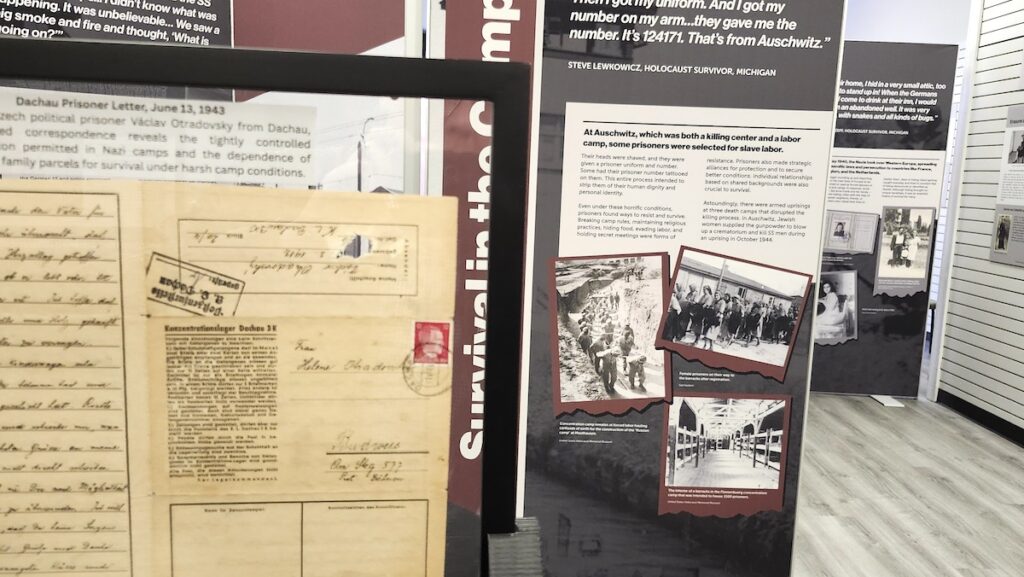
The local exhibits were assembled by Behnke and Camp, with assistance from a number of volunteers as well as community members who contributed items to the exhibit.
The windows in front of the space are lined with photographs that show the everyday lives of Jewish residents of Germany and neighboring countries before the Nazis came to power.
Large panels tell the story of Hitler’s rise to power, his use of antisemitic propaganda, and the tools the Nazis used to systematically murder Jewish people and other victims.
One section of the museum tells about different groups targeted by the Nazis. In addition to Jewish people, those groups included gay and transgender people, Jehovah’s Witnesses, political dissidents, disabled people, and the Roma and Sinti people, often called Gypsies.
Reproductions of articles from the Adrian Daily Telegram will allow museum visitors to see what residents of Lenawee County at the time would have known about the Holocaust through written accounts.
Visitors can also learn about the German prisoners of war who were held at a camp near Blissfield, and about the impact of World War II on the Hispanic community of Adrian.
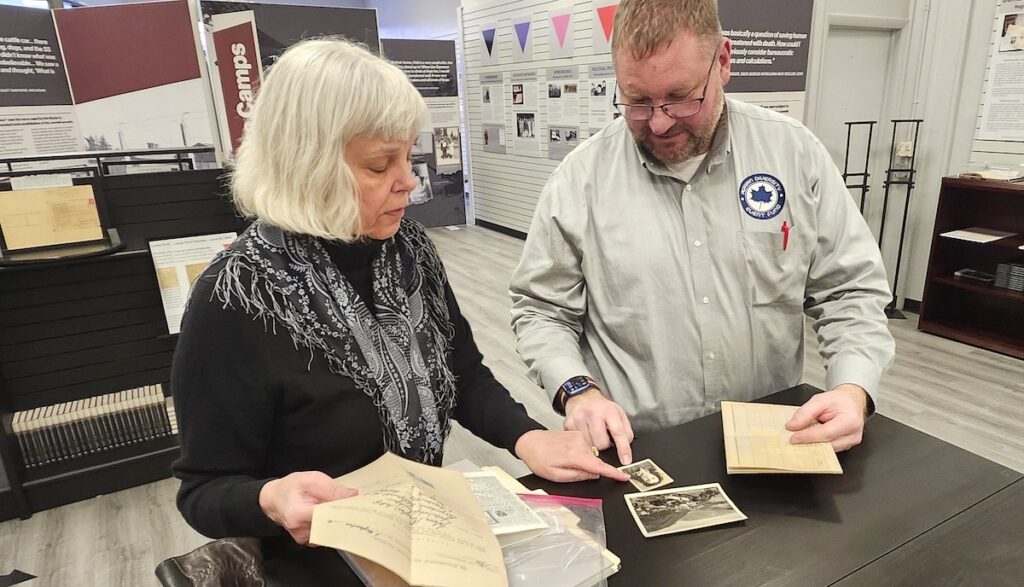
The artifacts in the exhibit include papers that belonged to Helene Riegler, a citizen of Austria who spent a year doing forced labor under the Nazi regime. Those materials were lent to the exhibit by her daughter, Sheri Reeves Bleam, who lives in Adrian.
Riegler’s papers will give people a sense of what life was like for everyday citizens under the Third Reich. Visitors will be able to see her Arbeitsbuch — an official document she carried with her that documents her year of unpaid forced labor serving German families in a hotel. The practice was so institutionalized that it had a name: Pflichtjahr, or “mandatory year.” Her papers are an illustration of the bureaucracy through which the regime controlled all aspects of people’s lives.
“She had to make sure that all of her papers were stamped by the Nazi government,” Bleam said of her mother, who was just a teenager at the time.
After the war, Riegler escaped from the area controlled by the Soviet Union and ended up meeting an American soldier, who she married. She came to the U.S. in 1947.
Also in the exhibit are letters written by political prisoners in the Auschwtiz, Dachau, and Mauthausen concentration camps. Those letters come from Adrian resident Michael Lehr, who is a collector of rare books and antique documents.
“In all cases they were heavily censored by the Nazis,” Behnke noted of those letters. “They always had to say ‘I am in good health’ and have a positive focus. They couldn’t talk about the slave labor they were engaged in or the conditions in the camp.”
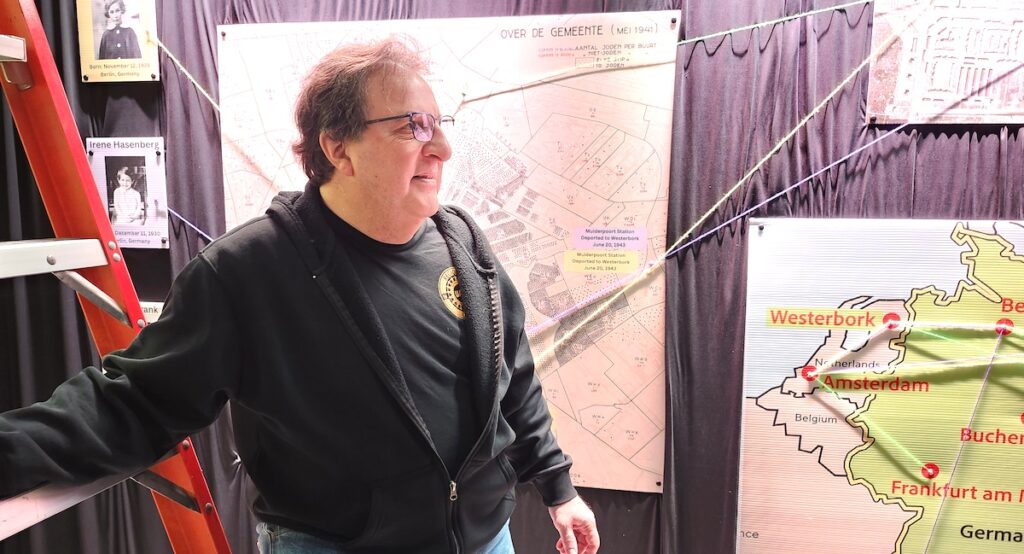
Assembling the exhibit was a community effort involving many volunteers. Joe Dimech built walls to be used for displays. Ron Chinn designed rotating displays that will allow guests to see both sides of the paper that the political prisoners’ letters were written on.
In addition, original paintings by local artists Kris Schmidt and Tom Thiery will be on display.
The public can visit anytime during the standard hours of Monday through Friday from 11 a.m. to 6 p.m., and Saturday from 11 a.m. to 5 p.m, but in addition, a variety of classes will be offered in the space.
The museum is a project of the Adrian Diversity Event Fund, an organization that seeks to recognize and celebrate the diverse cultural heritage of Adrian and Lenawee County.
For more information, go to adriandiversityeventfund.org.
Click here to read this story in Spanish.
De un clic aquí para leer la historia en español.
