
ADRIAN — As America celebrates its 250th birthday this year, plenty of orchestras around the country are programming concerts of patriotic music — and the Adrian Symphony Orchestra is no exception.
The ASO’s contribution to the birthday festivities, “Celebrate America,” is at 7:30 p.m. Friday, May 1, at Adrian College’s Dawson Auditorium.
Tickets are $41/$35/$27 for adults, $39/$33/$27 for senior citizens, and $22/$19/$15 for students. They can be purchased by calling 517-264-3121; online at adriansymphony.org; at the ASO offices in Mahan Hall, Adrian College, during business hours; or at the door beginning one hour before concert time.
A Classical Conversation with ASO music director Bruce Anthony Kiesling begins at 6:40 p.m. in the auditorium. It is free to all ticketholders.
As the concert title implies, the program is an all-American one, consisting of Copland’s “Fanfare for the Common Man,” Ives’ “Variations on ‘America,’” Hanson’s Symphony No. 6, Gershwin’s Concerto in F for Piano and Orchestra, Sousa’s “Washington Post March,” and, in a tribute to veterans, the “Armed Forces Salute” — in an updated version that includes the U.S. Space Force’s service song along with those of the other military branches.
Back in the 2024-25 season, the ASO programmed an entire “Season of Copland” without ever doing the “Fanfare for the Common Man,” one of the composer’s best known and most popular works. And many audience members let Kiesling hear about it.
“It was the most requested piece we didn’t do,” Kiesling said. But because the work was already on tap for this season, the omission was deliberate even if he couldn’t reveal that at the time.
If Copland’s music represents a certain “Americana” feeling, so too does the work of Charles Ives, albeit in a very different way.
Ives wrote the “Variations on
‘America’ ” when he was just 17 years old, originally for organ. It was later orchestrated by composer William Schuman.
Ives broke plenty of new ground in an era when “American” classical music was really yet to be defined. With this particular work, Kiesling said, “he claimed it’s the first use of bitonality,” which is a piece written in two keys at the same time. “To today’s ears, I don’t think it’s as dissonant as it seemed at the time. But it’s an example of pushing the limits — without going off the deep end.”
In fact, all of the classical pieces on the program push boundaries in different ways. “They’re all American takes on the various forms,” Kiesling said.
Howard Hanson’s Sixth Symphony, for example, is a departure from the usual “symphonies have four movements” structure. Instead, it has six, all of them very short; the entire work only lasts about 20 minutes.
“I loved the idea that this is meaty, heavy music, but it doesn’t need to be 60 minutes long to be that,” Kiesling said.
Hanson’s music “shaped much of the music of the 20th century,” he said, and he thinks the Sixth is not programmed nearly as much as it should be.
It was commissioned by Leonard Bernstein for the New York Philharmonic’s 125th year in 1968, but in comparison to the composer’s Second Symphony, the Sixth is relatively unknown and unrecorded.
Kiesling thinks this actually opens the door to a real opportunity for him and the ASO’s musicians. Because there is less of a recorded legacy of this symphony, “you don’t have 500 recordings to tell you how it goes, so there’s more room to interpret it.”
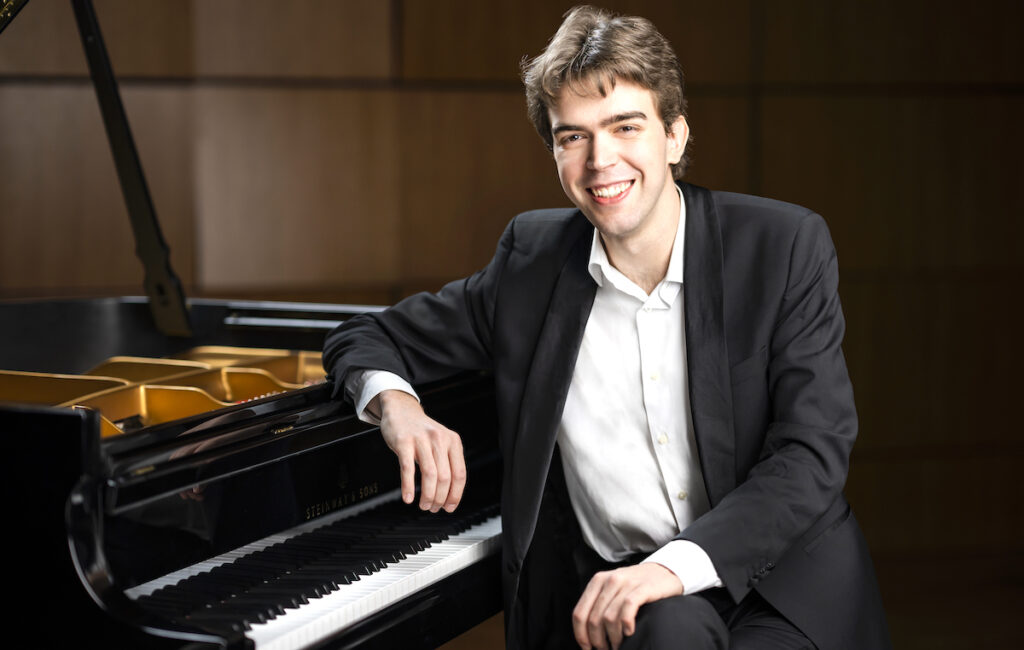
The ASO’s performance of Gershwin’s Concerto in F features guest pianist Albert Cano Smit.
Smit, an award-winning artist who is steadily building an international reputation, comes to the ASO stage at the recommendation of one of the orchestra’s audience-favorite guest soloists, pianist Dominic Cheli. As it turns out, Smit has recorded an album with the ASO’s most recent guest artist, cellist Sterling Elliott.
“He’s a sensational pianist, and I know our audience will love him,” Kiesling said.
Gershwin wrote the concerto on commission from conductor Walter Damrosch, who had been wowed by the “Rhapsody in Blue” and asked its composer if he could write a “proper” concerto.
It’s said that Gershwin had to go buy a book on how exactly to do so, but “that’s probably just a joke,” Kiesling said, since after all Gershwin had spent plenty of time in concert halls listening to lots of classical music.
At any rate, the work, which like so much of Gershwin’s music incorporates jazz idioms, has become a staple of the piano concerto repertoire. “I love the piece,” Kiesling said. “I especially love the middle movement. … It’s what makes this piece great.”
A concert of American music probably wouldn’t seem complete without something by John Philip Sousa, and for this performance that’s the “Washington Post March.”
The work will feature a guest conductor: retired Adrian High School band director Dick Barber, who comes to the podium thanks to the ASO’s annual auction. Board member Chip Moore bid on the guest-conductor opportunity offered at the auction, won it, and gifted it to Barber.
While any concert celebrating American music for the country’s upcoming birthday of course means having to choose from “more music than you can possibly include,” Kiesling said he selected these particular pieces because, to him, “they represent American ingenuity.”
“It’s a nice way to kick off the 250th,” he said.
