
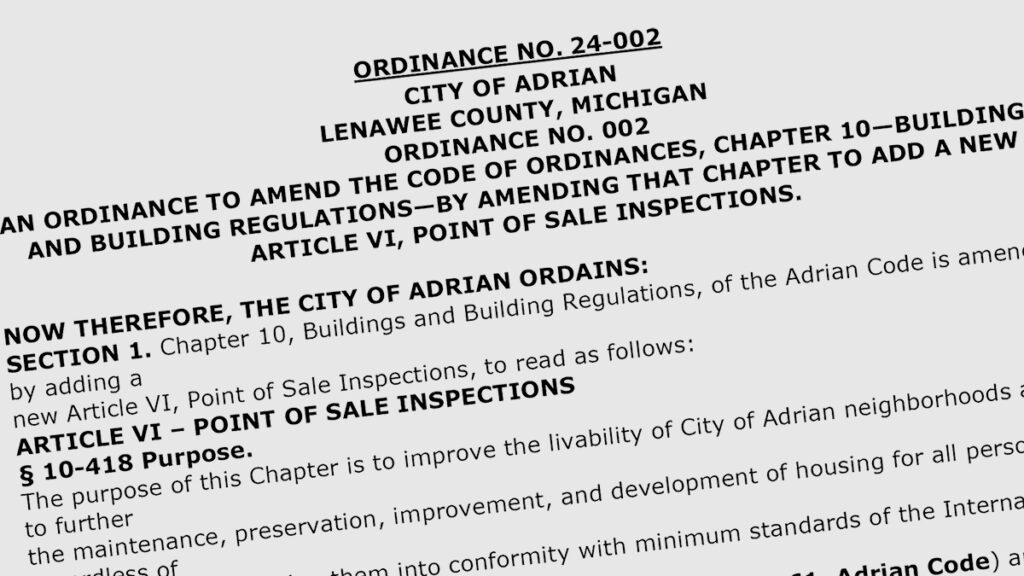
ADRIAN — Adrian’s point of sale ordinance would be repealed if a proposal on the city’s Nov. 4 general election ballot is approved by voters.
The ordinance was adopted by the Adrian City Commission in June 2024 and went into effect in November. It provides that a home being sold in the city must undergo an exterior inspection before it can be sold.
Inspections, which are currently being done at no charge because the city commission has not yet adopted a fee schedule, do not cover the home’s interior. Property is not required to be brought up to “like-new” condition but must comply with a set of requirements based on the International Property Maintenance Code. A home inspection report can be substituted for a city inspection. Either the seller or the buyer can fix any issues found.
A “yes” vote is a vote to repeal the ordinance.
Adrian Community Development Director Lisa Hewitt-Cruz summarized it this way: “While the ordinance aims to combat blight through mandatory exterior inspections before property sales, many residents feel it places an undue burden on homeowners — especially those with limited resources. This election will determine whether Adrian continues down this regulatory path or chooses a different approach to neighborhood revitalization.”
Adrian homeowner Carrie Smith’s pro-repeal group, Adrian Community for the Repeal of the Point of Sale Ordinance, gathered more than 2,200 valid signatures to get the measure placed on the Nov. 4 ballot.
The ordinance creates “lots of red tape. It makes the process of buying and selling more difficult,” Smith said.
“A sale should be between buyer and seller, not with government interference,” she said, and some lenders already require certain repairs be done before a loan is issued.
Smith said she and other members of the pro-repeal group have heard from everyone from sellers to those in the real estate business, such as Realtors and title-insurance professionals, about the headaches the ordinance has caused them.
In addition, her group believes that the ordinance was unnecessary in the first place.
“The city already has ordinances on the books as far as code,” she said. “It’s an enforcement issue. The city has to figure out how to enforce the ordinances it already has.”
According to information provided by Hewitt-Cruz at the city commission’s Sept. 15 meeting, up to that point 141 homes had been inspected, with 18 of those passing inspection without findings, 74 homes where the buyer or seller completed repairs prior to closing, and 49 homes where repairs were still in progress.
To Smith, those statistics are telling. “Out of 141 properties inspected, only 18 passed,” she said.
“Why are they waiting until there’s a property transfer? A house has been in that condition long before now. We all want to take pride in our community, but not at the expense of homeowners and their equity.”
She also noted that during the Sept. 15 presentation to the city commission, it was acknowledged that some of the enforcement actions stemming from the city inspections have been taken against neighboring properties that the inspector can see when looking at the house actually being sold.
Jim Kapnick, speaking for the Committee to Stop Blight, Crime & Drug Houses in Adrian, which supports the ordinance, said that the measure has been effective in helping address the city’s blight problems.
“I personally think it’s done what the overall intent is, which is to beautify the city of Adrian,” he said.
“It’s solving the bigger issue of making neighborhoods look better,” he added. The houses being inspected are all homes “that are going to look better. Without this, the [buyer] could buy the house and just leave it [as it is].”
And, he said, having the inspection done at the time the house is sold, when money is changing hands, is “kind of the nice thing about point of sale.”
Smith said she and the pro-repeal group believe there are better ways to solve the blight problem.
“No one wants blight or drug houses,” she said, in a reference to the pro-ordinance group’s name, but “what are things we can do to attack blight without attacking the rights of property owners? Lots of issues cause blight, and that’s what we want to see our leaders tackle.”
Previously:
- Proposed point-of-sale inspection rule draws strong opposition (May 24, 2024)
- Point-of-sale inspection ordinance passes in 4-3 vote (June 4, 2024)
- Push underway to repeal city’s point-of-sale inspection ordinance (July 10, 2024)
- Point-of-sale inspection ordinance is headed to a public vote next year (Nov. 19, 2024)
