
ADRIAN — In a wooded lot south of Adrian, smoke is rising through the air. Curious neighbors emerge for a closer look as a prescribed burn crew from Iron Creek Ecological Restoration sets fire to their neighbor’s land.
Jerry Liedel meanders across an adjacent fallow cornfield to chat. He gestures to the wooded area. “All this used to be farmland,” he says. At 75, he has witnessed decades of change in this landscape.
Nowadays, the parcel before us holds a young oak-hickory forest. Sugar maples tower over the low-lying areas, and a small stand of American plums grows nearby. It’s springtime. Garlic mustard sprouts everywhere. Tree leaves are unfurling, and the invasive bush honeysuckle draws a bright green line through the understory: a monoculture that has only become dominant in the area over the last 50 to 75 years, within Jerry’s lifetime.
As someone who hunts the property for deer, he expresses his appreciation for the burn — it will improve hunting visibility and help keep tick populations down. “They don’t make any more land,” Jerry told me. “The land we got, we gotta take care of.”
Landowners bear the responsibility of caring for their land’s health, yet many remain unaware of the degradation underway. And once established, invasive shrubs are stubborn opponents.
This is Dawn Thomas’ second time burning her land. Today’s fire will set back many of the invasive sprouts and saplings while helping to defend the remaining open areas.
Her property is not an outlier in Lenawee County. To the untrained eye, the abundant greenery makes the land appear vibrant and alive. But these dense invasive thickets leaf out early, outcompeting understory natives for sunlight, moisture, and nutrients, diminishing biodiversity and habitat, and ultimately degrading forests by reducing their capacity to sustain life. And fire alone isn’t enough to stop them. Restoration often requires years of an integrated approach to restore balance: manual removal, cut-and-poison work, repeated burning, monitoring, and sometimes reseeding with native species.
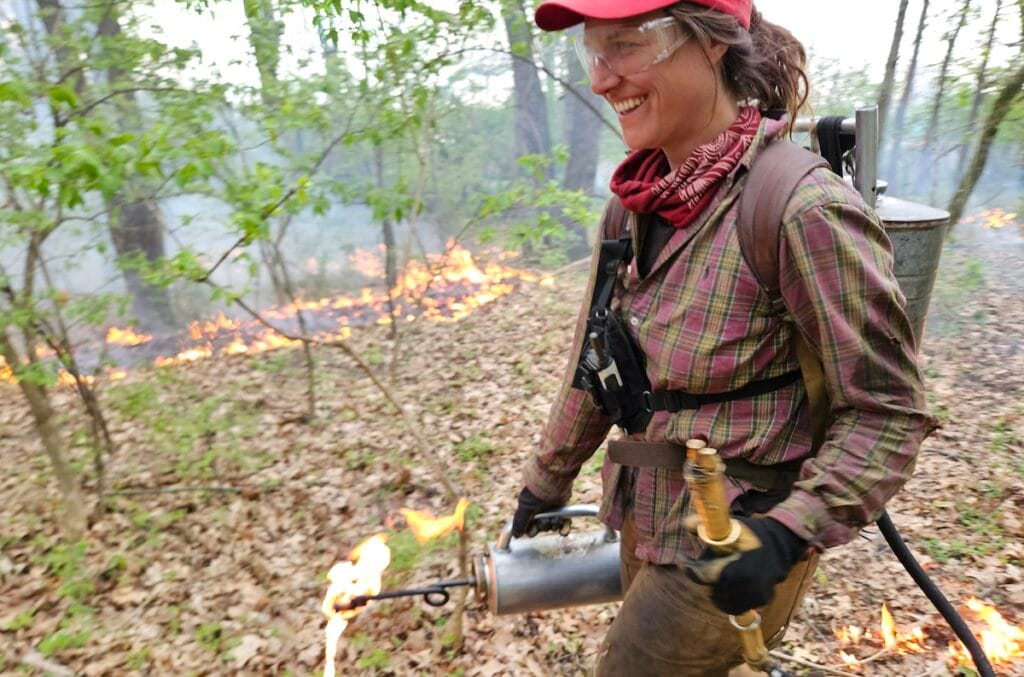
The wind blows, carrying flames across the dried oak leaves. Anna Snoeyink holds a drip torch and draws a line of fire along the perimeter of the woods. It is her 12th year on the burn crew.
As she passes, I ask her what motivates her. She smiles and shouts over the crackle of the fire, “I do it for the bloodroot!”
Bloodroot is a native spring ephemeral named after the bright red sap contained within the stem. Interestingly, this species is “planted” by ants, who are attracted to a tasty part of the seeds. They collect the seeds and bring them underground, where they are protected until they germinate. Bloodroot is one of many species that can benefit from actively restored land.
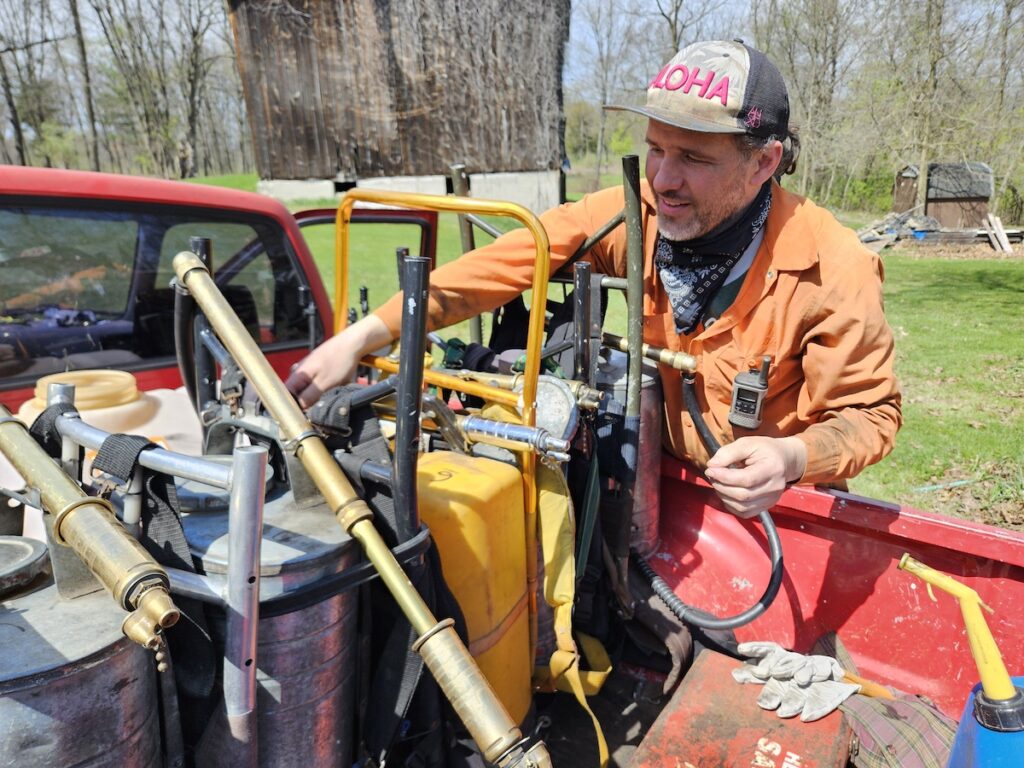
Jeremy Siegrist, with 18 consecutive years of conducting burns under his belt, is the most tenured member of the burn crew. “Native seeds are often waiting to emerge when the conditions are right,” he tells me. I ask him if he’s seen any major changes as a result of the fires. “I have,” he responds. “I’ve noticed a lot of changes. It doesn’t happen in one burn. But over time, a lot of the native species that do well with fire start returning … For the most part, the Midwest is a fire-dependent ecosystem.”
Although some of the prescribed fires that the Iron Creek crew lights may be the first in over a century, humans setting fire to the area is not new. Before European colonization, burning was conducted by indigenous peoples, and in some areas, it still is to this day. Traditionally, this is done for a variety of reasons, from opening areas for hunting and forage to maintaining travel routes. It was alongside this human-caused fire that the local ecosystems evolved.
By the time settlers arrived, vast tracts of fire-dependent landscapes, such as oak savannas, had formed. In the first half of the 1800s, surveyors mapped the entire surface of Michigan for sale and settlement. This map reveals that over 20,000 acres around what is today Hidden Lake Gardens were once an oak savanna. With over 99% of habitat lost, the oak savanna is now considered critically endangered, one of the rarest landscapes in the world. One of the main reasons for this: fire suppression.
In response to this, the Iron Creek crew has been working for over two decades, primarily in the Irish Hills, to restore fire. The work was initiated by Bob Kellum, who learned to burn from an Ann Arbor ecological restoration group called Plantwise.
Today, the Iron Creek crew has burned hundreds of acres. But they believe it takes more than prescribed fire to enact the cultural change that the land needs. Their work extends beyond fieldwork: helping people reconnect with the land through events, musical performances, and classes. Their educational arm, Open Grown School, offers workshops on wildflower identification, berry-picking walks for kids, and even a women’s chainsaw class. For those eager to roll up their sleeves, they also host an Intro to Prescribed Fire course.
As the smoke clears, the hope is that this ancient practice, revived by crews like Iron Creek, can be just one small part of a larger cultural shift toward land reconnection. Because in the end, as Jerry reminds us, the land we have is the only land we’ve got, and it’s waiting for us to take care of it.