

ADRIAN — Back in the 1970s, adults with developmental disabilities had few if any places in their local communities where they could socialize, have fun things to do, or even learn new skills.
And one day Jim Jones, the executive director of Call Someone Concerned and the Crisis Walk-in Center in Adrian, set out to change that in Lenawee County.
Jones had realized that many of the walk-ins at the crisis center were not actually in crisis but rather were developmentally disabled people who were simply lonely, bored, and needed somewhere they could feel welcome.
So, he approached friends in Civitan of Lenawee with his idea for a center where adults with such disabilities could socialize and enjoy activities and learning opportunities.
Civitan, along with many other members of the community, went to work on the idea. The result was what at the time was called the HOPE Recreation Center, with HOPE standing for Helping Others Through Projects and Experiences.
At that time, the developmentally disabled “were just starting to be integrated into the community and they didn’t know how,” HOPE executive director Katie O’Hotzke said. “Civitan had the mindset of changing the narrative.”
HOPE marks its 50th anniversary this year, dating back to the opening in 1976 of its first home in the Riverside Professional Building in Adrian. Over the years, as the need for space grew, the center moved to other sites in the city: first to 204 N. Winter St., then to 109 W. Maumee St.
Each building was quickly outgrown, and by the mid-1980s another move was needed. But a suitable building could not be found, and so the decision was made to build a new facility on land purchased at 431 Baker Street in Adrian.

With the support of community members, local corporations and organizations, and Civitan, more than $1 million was raised and the building was completed in August 1989.
The campaign “was spearheaded by Civitan, but Civitan was able to get almost our whole community involved,” O’Hotzke said.
“It was a great day when we opened this building,” Lenora Green said. Green is a longtime Civitan member who has held multiple offices both with Civitan and on the HOPE board. With two uncles who were handicapped and lived with her family as she grew up, Green had a long personal connection to people with disabilities. And she remembers the days when “no one wanted to be around these folks.”
Many lived in group homes where “they did nothing but sit,” Green said, because there was nowhere to go where they could meet other people and do things.
HOPE filled that need in the local community, and “we outgrew and outgrew and outgrew” each successive building until the facility on Baker Street, with its 14,000 square feet of space on 2.5 acres of land, was built.
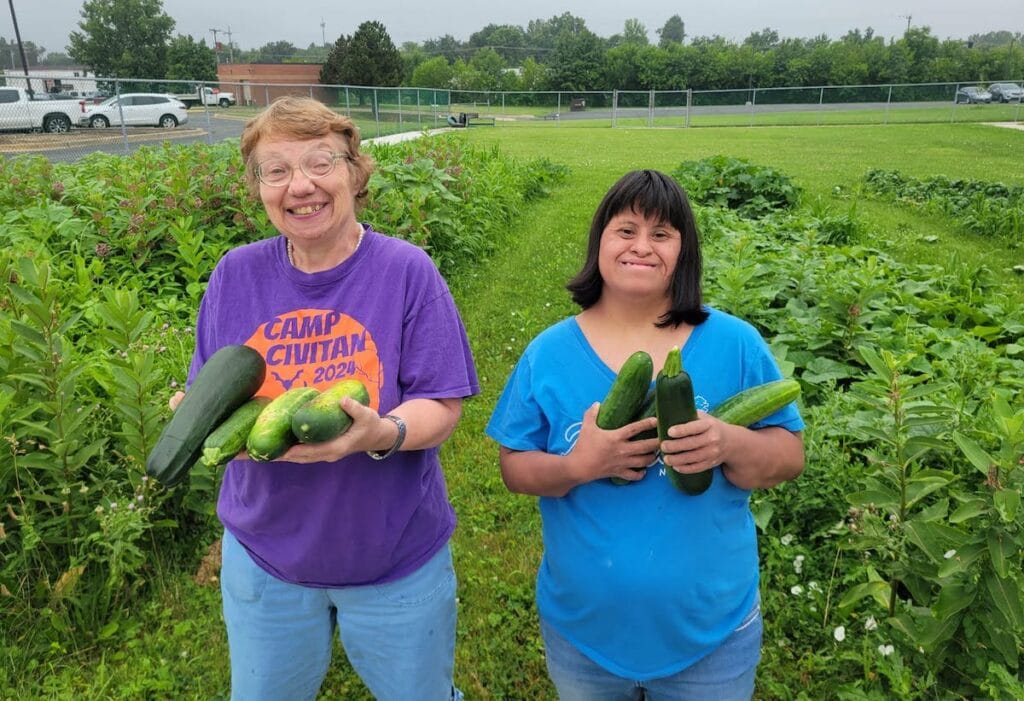
HOPE changed its name from HOPE Recreation Center to HOPE Community Center in 2006. Today, it offers its members a wide variety of activities including games, exercise, dances, classes in a range of topics, and even the opportunity to play basketball with the HOPE Hoopsters team.
The center serves developmentally disabled adults 18 and older. It currently has more than 100 members who come there from all over Lenawee County.
Throughout its history, the center has remained entirely funded by the local community, which board member Danielle Stepp said is “not the case for a lot of nonprofits.” It gives HOPE greater flexibility to meet the needs of its members than if it was receiving governmental funding.
“It’s been 50 years of being 100 percent community supported,” O’Hotzke said. “The community never stopped, and more and more community members have jumped on board over the years.”
“Nobody told this community ‘This is something you need to do,’ and no one rolled in with a program in a box,” Mary Martin, HOPE’s development director, said.
“This is a true grassroots effort. Fifty years ago they saw the need and addressed it, and 50 years later this is still very, very unique. … This community keeps supporting it and recognizes its value.”
One hallmark of the way HOPE does things is that “the participants have ownership,” Stepp said. Too often in society, “this population doesn’t get choice. They don’t get ownership. Here, they have activities and they have a say in what they do.”
That sense of ownership extends to taking responsibility for the center and for helping other people. They volunteer in the community, help out with tasks around the center, and “just know who needs their support” when it comes to other members, O’Hotzke said.
“There’s no better population than this group,” Stepp said. “They want to help, whether it’s out in the community or even here. Any activity, you get them coming up and asking if they can help.”
Parents of several HOPE members said the center makes a real difference in their children’s lives.
“He loves it,” Mary Ann Karn said of her son, Brian Church. “He’s a good basketball player and he has friends here.”
Brian volunteers for Meals on Wheels and has learned through basketball how to share and how to be part of a team, Karn said. Her daughter Heather, also a HOPE member, participates in activities at the center and “likes having things to do.”
Like Karn’s son, Kay Swartzlander’s daughter, Emily Hugus, enjoys being on the HOPE Hoopsters and getting to be part of a team.
Emily has been coming to HOPE for about 20 years now “and absolutely loves it,” said Swartzlander, who recently joined the center’s board. “This is a wonderful place for her. She can do things here with people.” Emily especially enjoys the center’s cooking and nutrition classes.
Angela French’s daughter, also named Emily, has been a member of HOPE for about seven years now. She didn’t want to come at first because “it’s hard to get her to do anything,” French said. “I made her and then she loved it.”
Emily French serves as the HOPE Hoopster’s manager, and in that role she videotapes the games to be posted on Facebook. “It’s hilarious,” French said. The camera gets pointed in all sorts of directions and “you can hear her trash-talking the other team. … She loves doing it.”
“I tell my friends that if you’re having a bad day you need to come watch the HOPE Hoopsters,” Swartzlander said, laughing.
Her daughter’s interests at HOPE include the center’s science classes — such as the one that had her bringing home a chrysalis to watch over all weekend, a task which her mother said she took extremely seriously.
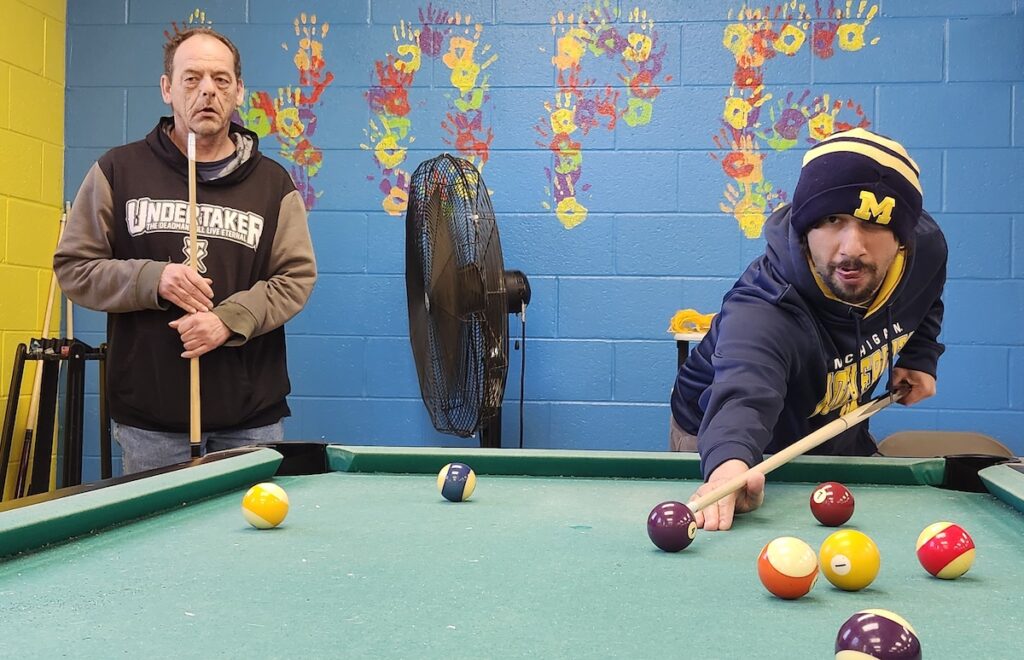
To these moms, as for other parents of people with developmental disabilities, knowing HOPE is a place where their adult children can make friends, be with their peers, do so many types of activities, and be safe for the day, is extremely important.
The center is “a special place that a lot of [communities] do not have,” Swartzlander said. “The members get five full days of programming and I’m just amazed at the kinds of activities they have. And the staff works to help build skills. It is an amazing place.”
One of the many things she finds “fascinating” about HOPE is “to watch these kids” — they may be adults, but to their moms, they’re all still their kids — “who’ve never been able to be leaders do that. Here, they get to be leaders. They get those skills. And they get to be happy.”
All three mothers praised O’Hotzke’s leadership and the connection she has with the members. O’Hotzke has worked at the center for more than a decade and became its executive director last year after serving as interim director for several months.
“Katie is amazing,” Karn said. “The fact that she knows these [members] and she understands them, and they love her.”
O’Hotzke, for her part, is confident that the HOPE Community Center will continue to provide its services to the county’s developmentally disabled residents, and their families, for a long time to come.
“I think we’re in a good position for the next 50 years,” she said. “The need never goes away.”
50th anniversary open house
- Date and time: Thursday, June 18, from 4-7 p.m.
- Location: HOPE Community Center, 431 Baker St., Adrian
- Details: This open house will include food trucks, a photo booth, outdoor games, cake and snacks, and tours of the HOPE Center.