
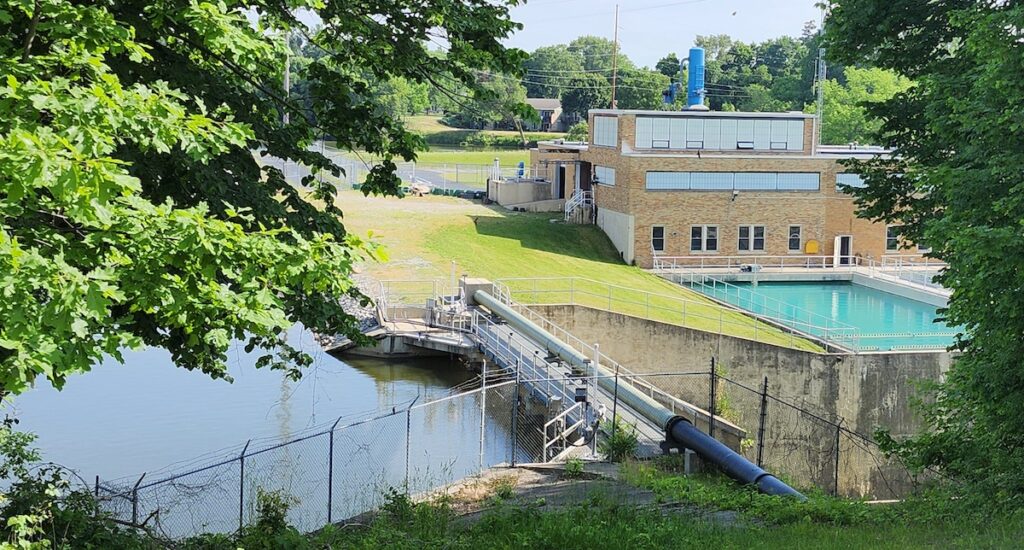
ADRIAN — Utilities director and acting city administrator Will Sadler gave Adrian city commissioners updated cost estimates on some of the options for upgrading Adrian’s water treatment plant at the Aug. 17 commission meeting.
The commission has been looking for ways to address persistent taste and odor complaints stemming from the organic compounds 2-Methylisoborneol and geosmin, which are created by algae in Lake Adrian.
Although most Adrian city water comes from a wellfield on Hamilton Highway, those wells aren’t able to fulfill all of the city’s needs, so the city is still partially reliant on Lake Adrian, a manmade reservoir that was created by damming Wolf Creek about 85 years ago.
Sadler said the equipment for ozone or advanced oxidation treatment would cost between $6.5 million and $8 million to purchase and install, depending on what option the city chose. In ozone treatment, ozone gas, a powerful oxidizing agent, is introduced into the water, where it dissolves and reacts with contaminants. Advanced oxidation is similar, but involves combining ozone treatment with other methods such as hydrogen peroxide.
He said Monroe uses advanced oxidation.
“They’ve used this for a long time,” Sadler said, “and their taste and odor complaints, they say, are few and far between.”
The cost could be spread out over 20 or 30 years, he said, and there’s a possibility of getting partially-forgivable loans from a state revolving fund to help pay for it.
Another strategy, reverse osmosis, would cost at least $25 million, Sadler said. He described that option as “really reaching.”
Sadler noted that in addition to the cost to get a new treatment method up and running, the city will need to figure out annual operating costs.
“Those are all things that we can get answers to before we make a decision,” he said.
Sadler said in order to pursue state funding, the city would need to conduct a pilot study. Ironically, to have a successful pilot study, the city would need to hope for poor conditions in the lake.
“It would have to be done at a certain time of year, because as we know the taste and odor is really bad in the spring and really bad in the fall, so we’d have to time it right,” he said. “And we would have to hope for a crappy lake, even though we don’t want to do that. But you’d want that because you want to get good data.”
Sadler said he views the state revolving fund as a more likely source of funding than grants, because although it is competitive, the available grants are even more competitive.
To apply for money from the revolving fund, the city would need to submit a notice of intent by Nov. 1, and then have a project plan completed by late spring. Sadler said the city has been scoring well on revolving loan fund applications in recent years.
“We’ve scored very well lately, so that’s good,” he said. “If we do score well, then they’ll make a decision probably late summer or early fall of next year, and that’s when the real work starts. That’s when we start design, and we’ll have probably about eight to nine months to do design work and get everything turned in for construction to start in 2028.”
Sadler also discussed the city’s attempts to get permission for a fifth well at the Hamilton Highway wellfield. Although a fifth well would be a backup for when one of the other four is offline for maintenance or repairs, Sadler said the state will probably not allow five wells to all be pumping at the same time, due to the capacity of the aquifer.
Being able to only use groundwater would be ideal, Sadler said, but “we’re not going to get rid of the lake. We just have to face that. We’re going to have that lake, so we need to figure out how to treat that better.”
In other discussion:
Commissioner Mary Roberts reported on her investigation into the possibility of getting a state legislative appropriation for water improvements. In the last state budget, she said, only three proposals for water projects were successful. She said getting a legislative earmark would be “a huge challenge,” and that if the city wants to pursue it, lobbying local representatives in Lansing will be essential.
Commissioner Bob Behnke said water treatment doesn’t fix the underlying problem of phosphorus and nitrogen runoff from upstream, which leads to algae growth. He said Michigan and Ohio have looser regulations on Confined Animal Feeding Operations (CAFOs) than Indiana, and that contributes to the problem. Commissioner Matt Schwartz said he was “absolutely astounded” by the information Behnke had shared about the difference between Michigan and Indiana laws, and that while local governments can’t control that, the city should try to influence state decisions that affect city water.
Previous stories:
- What’s going on with Adrian’s city water, and why? (June 8)
- Options for city water discussed at commission meeting (July 17)
Click below to watch the Aug. 17 meeting: