
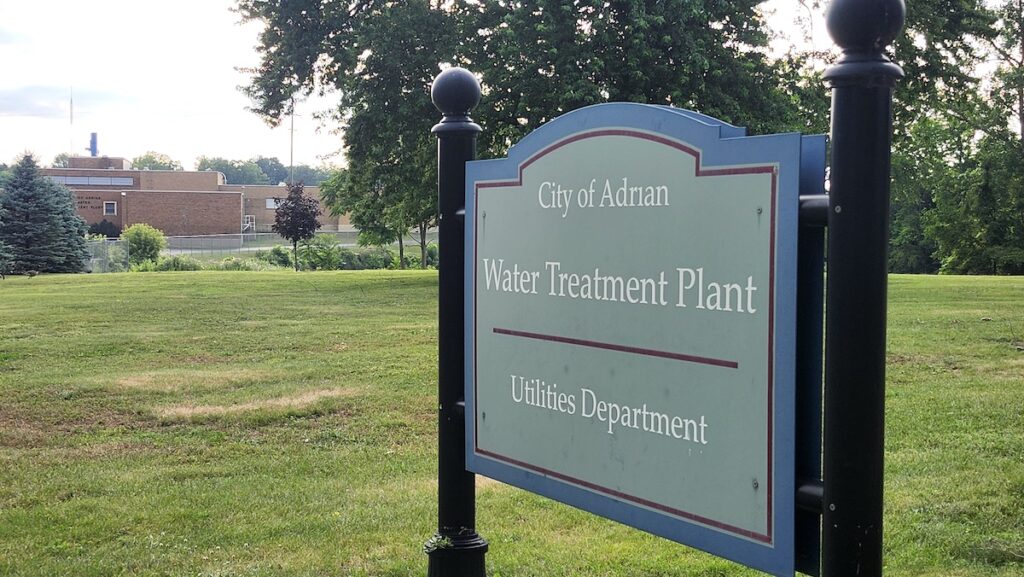
ADRIAN — Several options for dealing with complaints about the taste and smell of Adrian’s city water were discussed at the July 6 city commission meeting.
Adrian’s water is frequently high in the compounds 2-methylisoborneol and geosmin, which cause an earthy, musty taste and are difficult to remove using conventional treatment methods. The compounds come from algae growing in Lake Adrian, an artificial reservoir that was created about 85 years ago by damming Wolf Creek. The city gets most of its water from a wellfield on Hamilton Highway in Adrian Township, which came online a little under 20 years ago, but the limited capacity of that aquifer means water from Lake Adrian still has to be part of the mix.
Utilities director and acting city administrator Will Sadler outlined several options for commissioners — both ones that he believes are feasible and ones that he said are a long shot.
He emphasized that he was working off of old cost information, from a 2019 report by the engineering and consulting firm Tetra Tech, but said he hoped to be able to present better cost figures by the second meeting in August.
Ozone a good option: The first option Sadler discussed was ozone treatment. In that method, ozone gas, a powerful oxidizing agent, is introduced into the water, where it dissolves and reacts with contaminants. Sadler said both Ann Arbor and Monroe use ozone treatment. Monroe gets its water from Lake Erie — a body frequently plagued by harmful algae blooms — and Sadler said they still receive complaints, but the complaints are “few and far between.”
Sadler said ozone treatment would remove 90% to 95% of the geosmin and 2-methylisoborneol (or MIB). He estimated the cost at $7 million, but emphasized again that he was pulling numbers from the 2019 report. Monroe recently paid $800,000 for one of their three units, but that cost did not include installation.
Advanced oxidation: In advanced oxidation treatment, ozone treatment is combined with other methods such as hydrogen peroxide. This could remove up to 99% of the geosmin and MIB — “which would be fantastic,” Sadler said — but at a cost of at least $8 million or $9 million.
“Both of those are, to me, reasonably priced things that could be funded through grant programs to some degree, and definitely through the state revolving fund,” Sadler said.
Reverse osmosis: The most expensive treatment option that Sadler outlined was nanofiltration, or reverse osmosis. The price tag for this method would be more like $18 million, Sadler said, and it also comes with a major drawback.
“I’ve never been completely sold on reverse osmosis because it does generate a waste stream,” Sadler said. Between 15% and 30% of the total volume ends up being waste, packed with all the things that were filtered out of the water — and that has to go somewhere. Discharging it into the river poses environmental risks. And if it were put into the wastewater stream, Sadler said, “it could cause problems at the wastewater plant.”
Looking for more groundwater: The ideal situation, Sadler said, would be if Adrian could switch entirely to groundwater instead of relying on surface water, which is prone to any number of problems. But groundwater availability in the Adrian area is not good.
“If we could find groundwater, that would solve all the problems,” Sadler said. “It’s just that we know that we’re groundwater-poor in the area, and just randomly testing properties and spending $35,000 to $40,000 on a test well that may or not produce — that’s kind of a crapshoot.”
And then there’s the question of getting the water to city customers.
“If you do find an aquifer, it’s probably going to be further out than the one we’ve got,” Sadler said, adding that the cost of running a water line from a new well location would be between $2 million and $2.5 million per mile.
Additional algae treatment in Lake Adrian: Sadler said he’s also looking at a few smaller-scale options. The city uses ultrasonic treatment to kill off the algae that produces geosmin and MIB, and another unit would cost about $24,000.
Bringing back SolarBee machines like the city used to have in Lake Adrian would cost $140,000 for two units. SolarBees provide additional water circulation to discourage algae growth, but Sadler said it’s harder to know if they would be effective because the city had not yet started testing for geosmin and MIB the last time it had them in place. The previous units were retired due to their age and condition and replaced with sonar.
Funding options: Sadler said he would be asking Lenawee Now, which is administering a state-funded enhancement grant for projects in Adrian, about the possibility of using funds from that grant for purchases like additional sonar or SolarBee machines.
He also discussed the possibility of funding upgrades through Michigan’s State Revolving Fund. This fund provides low-interest loans that can be repaid over 20 or 30 years, meaning that while local taxpayer money does have to be used for the projects, the impact can be spread out over time. In addition, some principal forgiveness is usually available, meaning that State Revolving Fund functions a bit like a cross between a loan program and a grant program.
The city currently has three water projects in the State Revolving Fund pipeline. A project at the Broad Street pump station, which is part of the city’s wastewater management system, has been funded. Two other requests, for a lead service line replacement project and for improvements to the wastewater treatment plant, are still in progress and the city expects to hear this fall if they will be funded.
Sadler noted that qualifying for the State Revolving Fund is not a quick process. The city would have to submit a letter by November of this year stating its intent to apply for funding in order to be allowed to submit a full project plan the following spring. Then a notification of whether the project will be funded wouldn’t happen until fall 2027.
All told, Sadler said, “we would not be starting construction until fall of 2028.”
He also noted that funding is not guaranteed.
“It’s a competition,” he said. “We’re competing with everybody else.”
The city would have an advantage over some other applicants because the state considers Adrian to be an “overburdened community,” a status that gives it an edge in seeking funds.
“But they can’t fund everybody,” Sadler said.
Further discussion: Commissioner Chip Moore asked about introducing species that consume algae into Lake Adrian. “Have we thought about just putting 1,000 of whatever type of fish like to eat the algae?” he asked. Moore also mentioned zebra mussels.
“You want to be careful to not introduce any kind of invasive species,” Sadler replied. He also said that organisms like zebra mussels often avoid the algae that produce compounds like MIB and geosmin because they don’t like it either.
Michigan has been fighting problems caused by zebra mussels since the late 1980s. According to Michigan State University, although they do filter water, they can actually make problems such as algae blooms worse because they filter the beneficial algae that otherwise would compete with harmful algae, while leaving harmful algae alone. Their shells also cause sharp debris along beachfronts and lead to odor complaints of their own, since they release a foul smell when they die.
Pilot study may be needed: Sadler also told the commission that in order to qualify for State Revolving Fund money, the city may need to do a pilot study of whatever method is being contemplated, testing it on a small scale to make sure it will be effective.
Water treatment will be a discussion topic at upcoming city commission meetings. The commission meets on the first and third Monday of every month in the City Chambers Building, 159 E. Maumee St.
Watch the July 6 commission meeting here: