
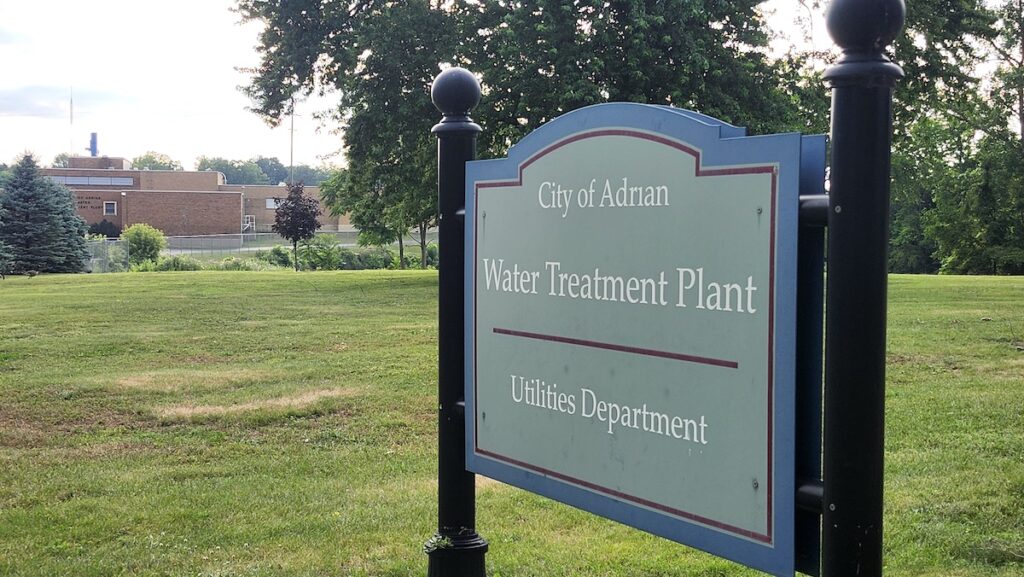
ADRIAN — City water was on the agenda again at the Sept. 8 Adrian City Commission meeting, with many commissioners saying they would like to proceed with a plan to seek state funding for an ozone treatment system to address taste and odor complaints.
Utilities director Will Sadler reported on a recent visit to the treatment plant in Monroe.
“They’ve used ozone since the 1980s, so over 40 years,” he said.
Sadler mentioned that Monroe has, in some ways, a more challenging situation than Adrian. The Monroe plant treats an average of between 6 million and 8 million gallons per day, while Adrian’s treats an average of 3 million gallons per day. Monroe takes all of its water from Lake Erie, which suffers from toxic algae blooms every summer. Monroe also has problems with invasive zebra mussels obstructing the water lines.
But he said Monroe’s taste and odor complaints are “very very few, and very far between,” to the point where Monroe doesn’t even test for taste and odor-causing compounds anymore.
“Ozone is a proven long-term treatment tool,” Sadler said. He noted that the city would only need to use ozone treatment on the portion of its water that comes from Lake Adrian, since the groundwater that makes up most of the city’s water supply doesn’t contain the compounds that are causing problems.
“It does require infrastructure, trained operators, ongoing monitoring, and careful integration with the rest of the treatment process,” Sadler said.
However, he added, “you don’t have to hire more people to run it, you just have to train them how to run it.”
Sadler said it may be possible to make improvements without increasing the cost to residents, because the city is currently paying on five bonds related to water and sewer projects, and the last of those will fall off the books in 2028.
The state has a revolving loan fund that the city can apply for. The deadline to submit a letter of intent for that program is Nov. 1.
While there has also been some discussion of grants, Sadler noted that those tend to be extremely competitive. He also said Adrian would be at a disadvantage because funding agencies wouldn’t consider taste and odor issues to be as pressing an issue as communities that are dealing with toxins.
The commission also discussed forming a committee of residents and commissioners to work on the water issue.
“Are we going to be looking at forming a committee to look at different options besides this?” commissioner Chip Moore asked. “Because I’ve been in talks with some people that possibly — the water plant in Toledo, Ohio, goes to Metamora, Ohio, which is only 18 miles away from Adrian — and depending what the water situation is in Blissfield, Madison Township, Adrian, there’s a good chance we could share the cost with that.”
Commissioner Bob Behnke said there would be a number of problems with trying to get water from Toledo. He said most water systems charge a higher rate for non-residents, and water transmission lines capable of supplying a city water system cost between $2 million and $2.5 million per mile.
“You’re talking about a $40 million interstate project or a $10 million, roughly, project that we can fix ourselves,” he said.
Moore said the city could pursue federal funding and ask Rep. Tim Walberg (R-Tipton) and Rep. Marcy Kaptur (D-Toledo) to serve on its water committee.
Commissioner Mary Roberts asked what the committee’s purpose would be.
“If the purpose for the committee is to go out and research grants, go out and find opportunities for us to apply for free money to pay for this, I’ll be for it,” she said. But she added that she favors having Sadler go ahead with preparing a funding request for ozone treatment.
Commissioner Matt Schwartz said he doesn’t object to forming a committee, but wants to make sure it’s an effective one.
“I would like to have informed opinions on the committee,” he said.
Schwartz said that when committee members are named, “they need to know that this is a highly important thing for the city, and it’s going to be time-consuming and it’s going to be informed decisions not based on emotions but based on facts. So when they come to the meetings, if they’ve got ideas, they should also be prepared to speak about the research they’ve done on those.”