
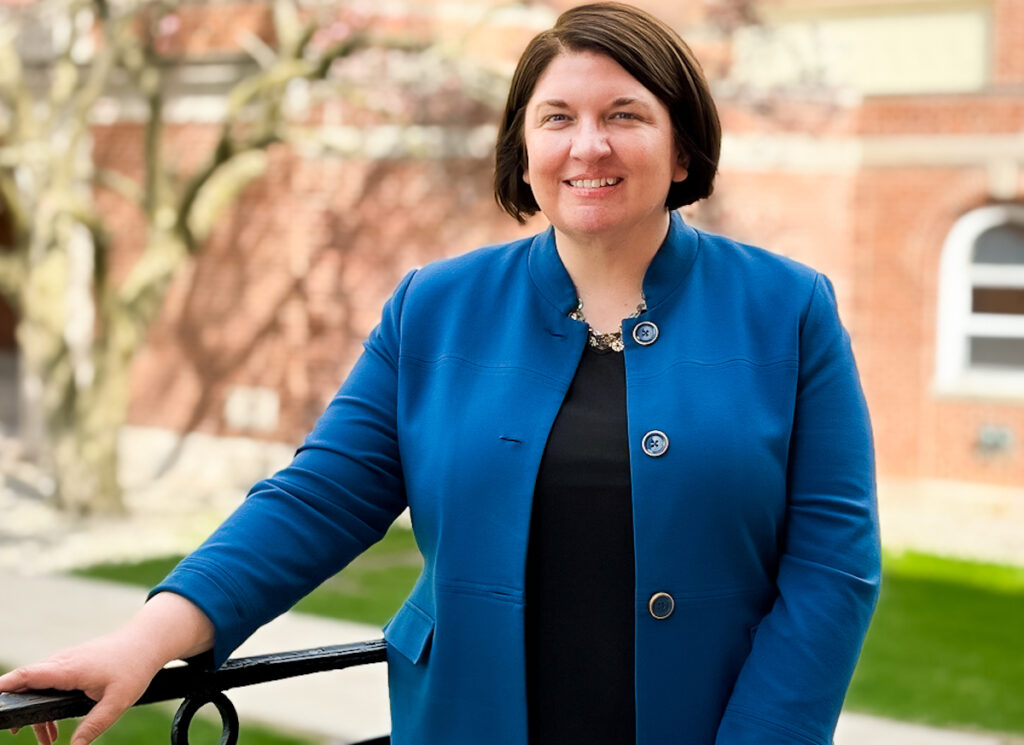
ADRIAN — There isn’t a playbook for closing a university, as Dr. Cheri Betz has been learning.
“There’s no manual,” said Betz, the final president of Siena Heights University, which will close its academic operations in June. “You might have guidelines — what accreditors need, what the Department of Education requires — but every day brings a new challenge you didn’t know you were going to face.”
And yet, in the middle of all that uncertainty, one thing has not shifted.
“The mission is the mission,” she said. “It always has been, and it always will be.”
For Betz, who has been with Siena Heights since 2002, the work this year has come down to one thing: people.
“Taking care of everyone — that’s what this year has been about,” she said. “An honorable closure.”
Siena has established approximately 20 teach-out agreements and more than 50 transfer agreements, ensuring that every student has a path forward.
“Every student will either graduate or have a pathway to another institution,” Betz said.
Some agreements came together quickly, while others were built around individual students and specific programs.
“A student might say, ‘I really want to transfer here — can you help?’” she said. “And we would work to make that happen.”
The agreements provide many paths for students and the timeline has helped faculty and staff make decisions without panic. Betz said they have also worked to make this final year as meaningful as possible for everyone.
Inside the president’s cabinet, one word has surfaced again and again. Sarah Stanley, executive director of marketing and public relations for the university, calls it brutiful, a term coined by author Glennon Doyle Melton. The responsibility has been tremendous for Betz, but she also is grateful to be at Siena now.
“It is heavy,” Betz said. “But there’s also a joy in knowing I get to be part of this — in a place that I love.”
A faith-filled person, Betz describes her role as something closer to a calling.
“When the announcement came, I asked, ‘Lord, what am I here to do?’” she said. “And the answer was clear: continue to serve.”
She signs every correspondence with the words, “In service to Siena,” because for Betz, serving others and making sure people are taken care of are her priority. That sense of service has shaped her leadership in a year when emotions often run just below the surface.
“You have to be patient,” she said. “People are processing this in ways they normally wouldn’t. We’re not going to get everything right. But we’re doing this in a way that honors the people who are here.”
Even as Siena Heights prepares to close, the focus has already begun to turn forward — to what the campus might become.
In early March, members of the Counselors of Real Estate Consulting Corps spent a week in Adrian meeting with more than 100 community stakeholders — nonprofit leaders, business owners, educators and arts organizations. They asked questions. They walked the campus. They tried to understand what might come next. They listened.
The effort was coordinated through the Phoenix Committee, a 12-member group representing the university’s Board of Trustees, the Adrian Dominican Sisters, campus leadership and the broader Lenawee County community.
The Consulting Corps also conducted a comprehensive site assessment. A formal report is expected to guide next steps, including environmental and structural analysis and the development of a Request for Proposals to attract potential partners.
“The goal,” Betz said, “is to make thoughtful decisions — not just for the buildings, but for the community.”
As the Phoenix Committee continues its work, Betz returns to the same idea.
“Siena is the people,” she said. “It’s a community.”
For more than a century, the university has shaped the lives of students, faculty, and staff who now carry that mission beyond Adrian.
“They’re the torch,” Betz said. “What you do matters. How you treat people matters. What you put out into the world matters.”
Related story:
