
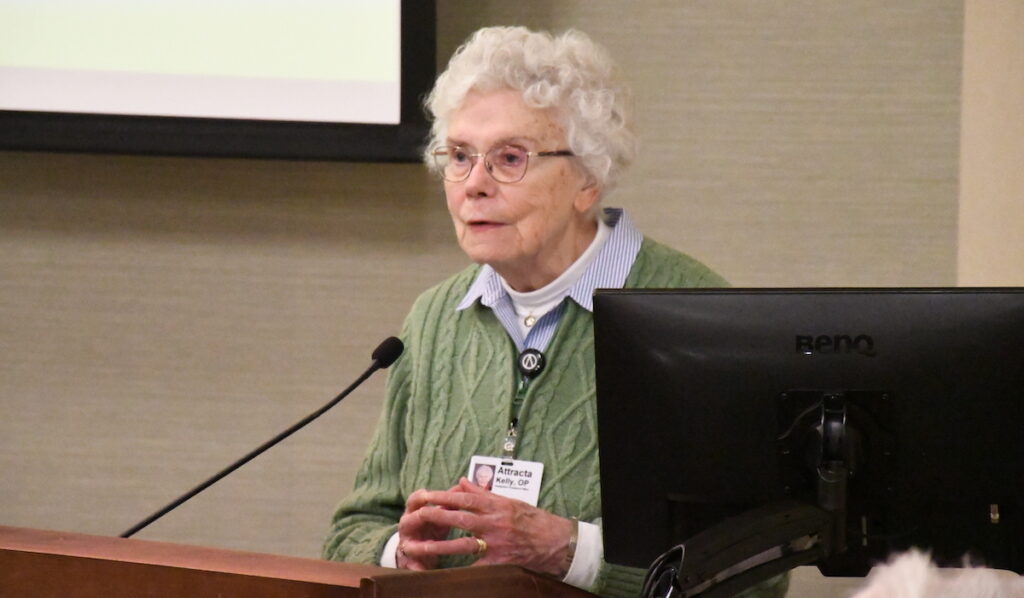
ADRIAN — The current status of immigration in the United States was the subject of a talk on Dec. 10 by Sister Attracta Kelly, OP, an immigration attorney and director emerita of the Adrian Dominican Sisters’ Immigration Assistance Office.
The talk took place at the Weber Retreat and Conference Center on the Adrian Dominican Sisters’ campus.
Kelly began with a description of the different terms used in immigration law:
- An immigrant is a person who migrates to another country to live permanently.
- A person who has been admitted to the United States for a specific, temporary period and purpose, such as for tourism, temporary work, or study, is a non-immigrant.
- A refugee is a person who lives outside their country of nationality and is recognized as someone who is unable or unwilling to return to that country due to past persecution or a well-founded fear of future persecution. Kelly noted that before any refugee comes to the U.S., they have already been evaluated by the United Nations’ refugee agency.
- An asylum seeker is a person who has fled their home country and is unable or unwilling to return to that country, due to past persecution or a well-founded fear of future prosecution, but that claim has not yet been proven or acknowledged. “According to international law, asylum seekers have the right to apply for asylum in a free country, and the free country must allow the person to present their case,” Kelly said.
- A Green Card holder, or legal permanent resident, is a person who has been granted authorization to live and work in the U.S. permanently. This person is normally eligible to seek citizenship after three or five years depending on circumstances.
- An undocumented person is someone who has migrated into the country in violation of the immigration laws of the country and without the legal right to be or remain in the U.S.
She also discussed the ways a person can obtain legal status. One is the family-based method, in which a U.S. citizen or person with legal status can petition to have a family member join them. However, that process can be extremely long, depending on both the relationship to the person and the country they are coming from. People coming from Mexico have an especially long wait, with the longest now approaching 25 years for a legal permanent resident who applies for a visa for a sibling.
Other methods include seeking asylum, which has become much more difficult during the Trump administration. People can also obtain legal status if they have been a victim of certain crimes, but Kelly noted that pathway is difficult. “They, in order to do that, have to report that crime to the police,” she said. “They also have to be brave enough — now remember, they’re undocumented — they have to be brave enough to go to court and testify in that case against the person who has committed the crime. That’s not an easy one.”
A person who is waiting for a visa to be available does not have any legal status, she said.
Nearly all methods of entering the U.S. or seeking legal status have become much more difficult, Kelly said.
As of Dec. 2, she said, immigration officials have been instructed to place a hold on all asylum applications regardless of where the person comes from. In addition, the Trump administration has said it will revisit the status of about 223,000 people who received asylum during the Biden administration.
The administration has also ordered a halt to processing of applications for permanent residence for refugees who entered during that period.
Temporary protected status, which allows people to remain in the U.S. temporarily due to conditions such as war or disaster that prevent them from safely returning home, has been ended for people from Afghanistan, Cameroon, Ethiopia, Honduras, Nepal, Nicaragua, South Sudan and Venezuela. Temporary protected status is scheduled to end soon for people from Haiti, Yemen, Somalia, El Salvador, Sudan and Ukraine. Attempts to end the status for people from Burma and Syria have been temporarily halted by a court order.
The administration has also eliminated a humanitarian program that provided people fleeing instability in Cuba, Haiti, Nicaragua and Venezuela an opportunity to legally enter the U.S. as long as they had a U.S.-based supporter and passed a security vetting. Anyone who entered under this program is required to leave.
Deportation efforts are being assisted by the IRS, although Kelly said IRS data is normally confidential. She noted that this is possible because undocumented immigrants paid an estimated $90 billion in taxes in 2023, about $56 billion of it in federal taxes.
Agents have been ordered to arrest at least 3,000 people per day, and immigration judges — who, unlike judges in most courts, work for the executive branch — have been instructed to help speed up deportation.
Kelly also noted that people are being arrested when they show up for hearings or check-ins with ICE, which is what they’re supposed to do.
“This creates terror and fear for individuals and families, because now they go ‘Is my hearing a trap? Is it something just to get me there? Is ICE waiting to deport me?’ But they have no choice. They have to go to the hearing,” she said.
In addition, there used to be a list of places where agents would not carry out immigration arrests — such as schools, hospitals, places of worship, playgrounds, disaster shelters, or ceremonies like weddings and funerals. That policy was rescinded on the day of Trump’s inauguration.
The Supreme Court has also ruled that a person can be detained based on their race or ethnicity, their presence at a particular location, the type of work they do, or speaking with a particular accent. Kelly said this has led to many U.S. citizens, especially Latino men, being arrested by agents who treat them roughly and refuse to look at their proof of citizenship.
“There are credible reports of Americans having been dragged, tackled, beaten, tased, shot and having their necks kneeled on by immigration agents,” she said. “At least three U.S. citizens were pregnant when agents detained them.”
However, she said, people can do things to protect their neighbors.
Sister Mary Kay Homan, OP, spoke about what federal agents have been doing in Evanston, Illinois, and how residents have responded.
Homan said she recently visited Evanston, where agents have been getting more and more aggressive.
“They went into a local grade school with guns drawn and stopped a Halloween celebration. They have been driving around Evanston in unmarked cars with darkly tinted glass windows,” Homan said.
A few days before her visit, she said, “a woman was following a car with ICE agents. The agents entered the intersection and suddenly slammed on their brakes so that the woman in the car behind rear-ended them. They pulled the woman from the car, not gently I might add.”
She continued: “The statement from ICE was that their car was slowing down to make a U-turn, and that is a lie. I was in that intersection and there is no way you can make a U-turn there.”
Homan said the amount of violence used by the agents was shocking.
“A man tried to protect the woman taken from the car,” she said. “He was bodyslammed to the road and beaten by three ICE agents. … The agents deployed pepper spray against the large crowd of residents. They pointed guns at people videotaping the incident. Three people were detained, all American citizens I might add, the driver of the car and two bystanders. The three who were detained were later released without being charged or even fingerprinted, probably because there were so many witnesses and videos.”
Homan said the people of Evanston have banded together to make sure ICE agents’ actions are documented, using whistles to alert each other to situations in progress.
Kelly said it’s useful to make sure agents know their actions are being witnessed and recorded.
“If ICE is doing a very aggressive pickup, if people surround and are videoing what’s happening, I think it calms them down and they are not so terribly aggressive then,” she said. “If we see ICE in the area, it helps enormously if people gather around … usually if there are people there, then ICE becomes more civil.”
She called on people to help their neighbors, quoting the words of Pope Leo XIV: “At a time when people feel powerless to help migrants and refugees, Christians must continue to insist that there is no justice without compassion, no legitimacy without listening to the pain of others.”
For more information about the Adrian Dominican Sisters’ Immigration Assistance Office, go to adriandominicans.org/Immigration-Assistance or call 517-266-3526.
Click here to read this story in Spanish.
De un clic aquí para leer la historia en español.
