
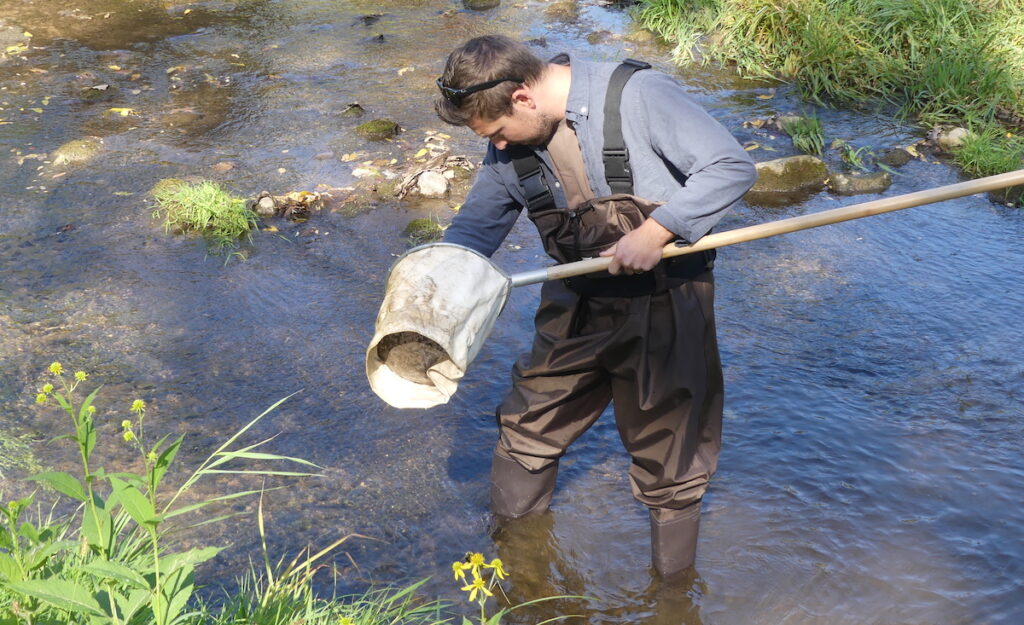
TECUMSEH — It’s early October in Tecumseh, and leaves float down Evans Creek. The yellow flowers of wingstem bloom along its banks, attracting a steady stream of bees. In the water, Lydia Lopez and Sean Dennis from the River Raisin Watershed Council are dipping cloth nets in search of tiny aquatic animals called macroinvertebrates. These backbone-less animals, such as pollution-intolerant mayfly nymphs, provide essential clues about the condition of local waters.
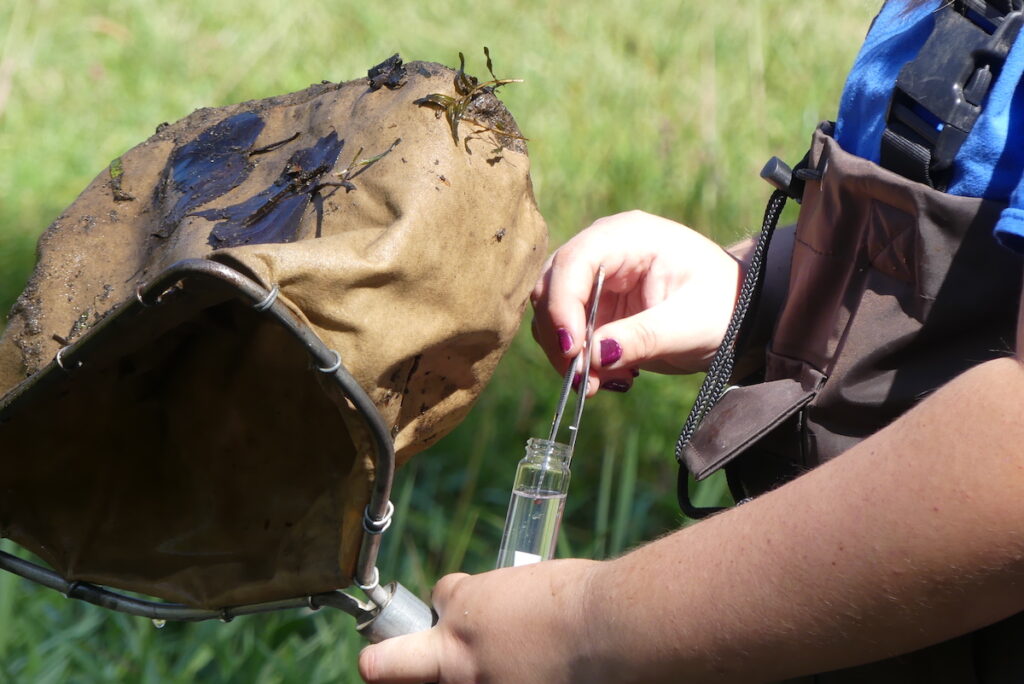
The watershed council and community volunteers conduct these searches several times a year as a part of ongoing water “check-ups.” I watched as they worked: nudging the submerged leaves and rocks with wading boots to flush out the organisms, dipping nets, peering closely, and using tweezers to place them in a glass beaker for further study. Several crawdads were captured and thrown back. Bits of dirt and debris stuck to the nets and Lydia poked around in them, looking for movement.
We talked while they worked. “A lot of people don’t understand that waterways are like nesting dolls … right now we’re in Evans Creek, which leads to the River Raisin, which leads to the Western Lake Erie Basin, and then … the Atlantic,” Lydia told me. As she spoke, I thought of the Skeleton Dance song and “the leg bone’s connected to the knee bone!” bounced through my mind. But she’s right. The River Raisin and its tributaries are the hydrologic lifeblood of our region, and the vitality of those waters and everyone who depends on them is intertwined.
From the creek, Lydia suddenly exclaimed. She had found a leech. Leeches are pollution-tolerant. While their presence alone doesn’t necessarily indicate poor water quality, a high population of leeches in the creek might signal degraded waters.
The creatures that made it into today’s sampling beakers were destined for microscopic scrutiny and sorting back at the office, where they would contribute one small piece of a larger picture of watershed health. But what other metrics are used?
In 2024, a foundation grant led to the release of the first River Raisin Watershed Report Card. This assessment tool compiled information across six different categories: water, economy, ecosystem, human health, infrastructure, and recreation, to determine a “grade” for our local watershed. We got a C.
“It is one of the most useful tools in our toolbox,” Lydia said.
Report cards were also issued for neighboring watersheds, providing a valuable comparison. The Huron Watershed scored a slightly higher grade. One of the factors bringing down our watershed score is E. coli bacteria. “Not having a countywide septic code really impacts us,” Lydia noted. “We sample at 14 locations in this subwatershed, and we have for three years. The highest E. coli site that we have is a drain going between a couple of residential properties. One of the houses got bought recently. There was an inspection done, and they changed their septic tank. Immediately after that, the E. coli levels went down significantly. It’s a small win, but it’s still a win. We’ve got to do that on a statewide level.”
Another major issue is turbidity caused by sediments from unprotected streambanks. “I see the impacts that humans have on the environment pretty directly,” Lydia said. “We were sampling in Brooklyn, and there was a crew taking down trees along the river. … Those trees hold the bank in place. They didn’t have a silt fence while doing the work. The water was ankle deep, and you couldn’t see the bottom because of the amount of sediment.”
Nutrient loads from Nitrogen and Phosphorus-containing fertilizers are also a significant source of pollution and have an outsized impact downstream. They flow into Lake Erie and concentrate, leading to toxic algal blooms. When the blooms decay, they deplete the oxygen in the water, forming thousands of square miles of dead zones where fish and other aquatic life cannot survive. The toxins in these blooms have far-reaching consequences on everything from recreation to the economy.
This scale and type of watershed pollution is relatively new in the 14,000-year-long history of humans living in the area. While earlier residents had to contend with the pathogen risks inherent in drinking untreated water, the 20th century brought periods of unregulated industry, agricultural expansion, and widespread deforestation, which all dramatically intensified water pollution. And although many contaminants will persist for generations beyond our own, there is much that we can do to restore the health of our waters today.
Choosing not to fertilize lawns, especially for residents living near lakes or streams, would prevent excess nutrients from entering the waterways. For those who continue to treat their lawns, planting vegetated buffers can help to block runoff and reduce erosion.
As the watershed in southeast Michigan with the most agriculture, farmers can contribute greatly by adopting best practices. The Farmer-Led Watershed Conservation Group is one organization that is already committed to doing this, advocating for precision fertilization, buffer strips, cover crops, reduced tillage, and erosion mitigation to prevent polluted surface flows from draining into Lake Erie. “There are people out there that care and are trying to do the right thing. We want to support them and to learn from them,” said Lydia.
Watersheds have unique characters and potentials. Some watersheds are defined by wide-spreading, fast rivers. Our 150-mile long river, named after the wild grapes that grow along its shorelines, is known for being one of the crookedest in the world. I asked Sean and Lydia — if the River Raisin were a person, which words come to mind in describing them?
“Quiet power,” said Sean. “The river is unassuming. It doesn’t get very wide. It’s not like the Maumee that you can fit a bunch of boats in. … People don’t realize how much of an impact it has on their lives.”
Lydia thought about this and paused for a moment. “Giving,” she said.
The River Raisin Watershed Council hosts regular events and is always looking for volunteers. To get involved in helping to co-steward the watershed through stream surveys and other activities, visit www.riverraisin.org.