
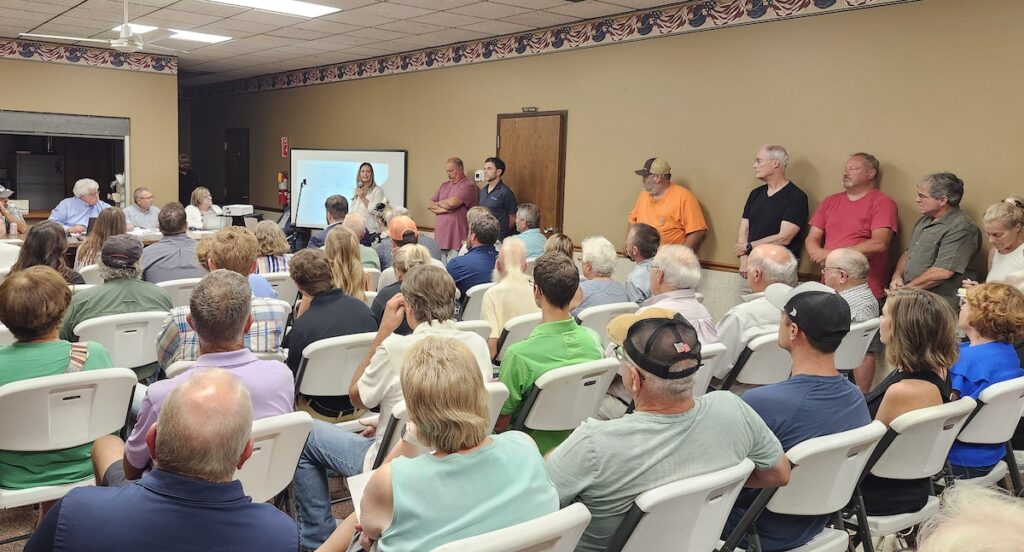
DEERFIELD — About 80 people filled the Deerfield Township Hall on Aug. 13 for a public hearing on the proposed Glacier Meadows Solar project.
The project is being proposed by Orsted, a Danish energy company, and is designed to generate 200 megawatts of power, or about enough electricity for 50,000 homes.
Orsted has about 2,200 acres under lease, with about 1,200 acres slated to be fenced in and have solar panels installed. The project area is in Blissfield and Deerfield townships, with the majority of the acreage being in Deerfield Township.
Marla Korpar, a member of the development team, spoke at the beginning of the hearing. She said the project would generate about $35 million in local property tax revenue over the 35-year life of the project. About 300 people would work on the project during the construction phase, she said, and then there would be three permanent full-time employees taking care of operations and maintenance. The power would be routed to the substation on County Line Road.
Korpar also discussed the setbacks involved in the project, saying they are 300 feet from any occupied buildings on nonparticipating properties, 150 feet from the property lines of nonparticipating properties, and 50 feet from public right-of-ways.
One of the speakers during the public comment portion of the hearing was Viviana Villasmil, a representative of First Solar, the Perrysburg, Ohio company that Orsted has contracted with to manufacture its solar modules.
“We are the only U.S.-headquartered company among the world’s largest solar manufacturers. The rest of the list is completely dominated by Chinese state-subsidized companies,” she said.
Responding to a resident who brought up Chinese influence on the U.S., Villasmil said that First Solar has an entirely domestic supply chain. “You don’t want China, you want independence from all of those folks, this is how it starts,” she argued. “Having our own domestic supply chain and our own domestic solar generation.”
Villasmil had asked to be able to move her speaking slot to the end of the meeting so that she could publicly answer any other questions that came up, but was denied.
Opponents of the project said that farmland should remain in use for agriculture.
“If farmers do not possess the skill to produce profit from farming, they should sell their farmland to the many other farmers who do possess this skill,” said Renee Gordon of Deerfield. “This is agriculture territory, prime farmland, not solar territory.”
Connie Loar of Blissfield said she will be 300 feet from the facility.
“I don’t need to look out on my porch and see panels,” she said. “I don’t want it. We don’t want it. If we have solar into all this ground, where is our vegetables and everything going to come from? It’s going to be gone. We need to keep this ground farm ground because that’s what we are. Farm people.”
Karlene Goetz of Whiteford Township said she lives one-half mile from the proposed solar farm and asked, “Why do you developers insist on putting these panels on the very best farmland that exists?”
Supporters said that leasing land to a solar developer can help farmers diversify their income, and that, like growing crops, it’s a way to use their land to meet a need.
“As a fifth-generation farmer of this land that we’re speaking about, I would like to speak on behalf of the underrepresented farmers and landowners in the room,” Eric Keller of Deerfield said. “As long as we have owned and cared for this dirt, we have used it to grow commodities based on the needs of the country.”
Keller said that 14,950 U.S. farms stopped operating in 2024, and the country’s current total of 1.88 million farms is down from 6.8 million in 1935. He said farms are struggling, and leasing land “doesn’t mean selling out or giving up,” but will provide farms with a source of steady revenue.
Others said it’s a question of property rights.
“I get that you guys don’t like it, you don’t want to look at it,” said Tom Creque of Sylvania. “It’s not your land.”
Andrew Hall, representing to Michigan Land and Liberty Coalition, said: “I think this comes down to one thing. Is a farmer allowed to do with their land as they see fit, in their best economic interests?”
“You can’t force a farmer to farm a certain kind of crop, you can’t force them to farm certain parts of their land,” he said. “We shouldn’t be telling them, if they want to lease plots out to a developer, that they can’t do that.”
Hall said if local governments worked with developers instead of shutting them down so that the decision moves to Lansing, they would have more power to negotiate for things like better screening between the installations and neighboring properties.
Another speaker from the Michigan Land and Liberty Coalition was Noah Buttita.
“Property rights have been the backbone of prosperity and liberty in this country, and those rights don’t disappear because we don’t like the way something looks,” Buttita said. “This project is rooted in landowners’ rights and economic freedom.”
Others, however, said property rights aren’t absolute.
Barry Fawcett of Deerfield talked about being able to hear the buzzing of the substation from his house, and said, “I get farmers can do what they want with their land, but when they sell it to corporations like this for solar fields, it kind of impacts everybody.”
Tyler Fall of Deerfield said, “If I want to have a junkyard in my yard, I can’t have a full-on junkyard.”
Renewable energy advocate Peter Sinclair of Midland said that solar and wind power are the best short-term tools to keep energy costs from rising, and urged people to go to his website, sun101.org.
There was also a contentious moment between township officials and attorney John Weiss, representing Orsted, who asked the township to officially reject the plan so that Orsted could go on to the next step as defined by state law, which is applying to the Michigan Public Service Commission. He said the township has an overlay that clearly doesn’t allow Orsted’s project, so “it’s my position that you’re wasting everybody’s time.”
“We’re here in good faith,” he said. “We’re not entirely sure that that’s being reciprocated.”
Rouget Road Solar
Another meeting took place on Aug. 26 at the Blissfield American Legion for a different project that is at a different phase in the application process. Having been unable to get approval from Palmyra Township, RWE Clean Energy is now in the process of seeking the Michigan Public Service Commission’s approval to build Rouget Road Solar.
The properties included in Rouget Road Solar are generally located south of Deerfield Road, north of Gorman Road, east of Ogden Highway, and west of Robb Highway.
The Aug. 26 meeting was led by RWE as part of the process required by the Public Service Commission. Set up on easels around the room were maps of the project and renderings of the landscaping buffers, a mix of evergreen and deciduous trees, that RWE said they plan to put in.
Project development manager Kevin Cole said RWE is the third-largest renewable energy company in the U.S.
“Our experience allows us to build responsibly and deliver clean and affordable energy to the grid,” he said.
The proposal is for a 175-megawatt installation, enough to power about 30,000 homes. Cole said RWE hopes to have it operating by the end of 2028. He said it will generate $33 million in property tax revenue over 35 years, with 320 people being employed during construction and four permanent employees operating it once it’s built.
“These guys are going to need food, housing, fuel, and many other items that will be a boost to the local economy,” he said of the 320 temporary workers.
One neighbor who spoke against the project was Richard Eaton, who said he moved to Palmyra Township from California intending to be around farmland.
“You’ve surrounded my house on three sides,” he said. “Would you raise your family in the middle of a solar farm?”
Ryan Powell of Palmyra said, “Our fight has never been with the people who own the land here. I understand you’re trying to do what’s best for your families. Our fight is with the system and the representatives of that system that believe rural America can be industrialized without its consent.”
Conrad MacBeth of Deerfield said solar facilities don’t belong on agricultural land.
“Put it in a brownfield, not in a farm field,” he said.
One speaker for the project was Adam Leckler of LaSalle Township.
“Farms are failing at a massive rate,” Leckler said, “and we need the ability to diversify our lands into something that we feel will generate revenue, not only for ourselves but for our communities.”
Tom Creque of Sylvania called solar installations an ideal project because, unlike many other land uses, they generate revenue without drawing on local water, sewer, or other infrastructure after they’re built.
Paul Wohlfarth of Ottawa Lake said a lot of misinformation is being circulated to turn people against solar power.
“There’s a lot of misinformation out there that’s not true, and people are being told a lot of lies,” he said.
After public comment, RWE representatives addressed a variety of questions. One had to do with what happens if the company goes out of business. Cole said that solar developers are required by law to put money into a decommissioning bid held by a third party so that, even if the company goes bankrupt, the money is still there to be used for restoring the land to its original condition at the end of the project’s life.
Responding to questions about why these sites were chosen, Cole said there were three factors — the flat land, the availability of transmission lines, and the fact that there were property owners in the area interested in leasing.
He also discussed the impact on soil, saying that solar developments don’t negatively affect the soil and actually improve it because the soil has time to regenerate.
“The soil is resting,” he said. “We plant pollinator species around the solar panels, and every year they grow and they bloom and they die, and they enrich the soil.”
On the subject of water, Cole said that solar facilities don’t use any water and are required to work with local drain commissions to make sure they don’t alter drainage patterns.
RWE doesn’t use concrete pads, Cole said, instead driving the pilings into the ground to an average depth of 14 feet. This led to a question about what happens if drainage tiles are damaged. Cole agreed that, no matter how hard they try, it is inevitable that some drain tile will be damaged, but that the company hires a contractor — when possible, the drainage tile installer who has put in most of the tile in the area — to follow after and fix it.
“When there is something that needs repaired, we repair it until it’s right,” he said.
Note to readers: The owner of Lenawee Independent Media, which publishes the Lenawee Voice, is one of the property owners who has an agreement to lease land to the Rouget Road Solar project. Because we are writing about a topic in which this newspaper has a direct financial stake, we feel it is only appropriate to disclose this to you.
We have made every effort to cover this story as fairly as we would cover any other. However, we do not ask you to take our word for it. The Aug. 26 meeting about Rouget Road Solar was also attended by The Advance in Blissfield. We encourage readers who are interested in this topic to purchase the Sept. 3 edition of The Advance and read their story as well.
