
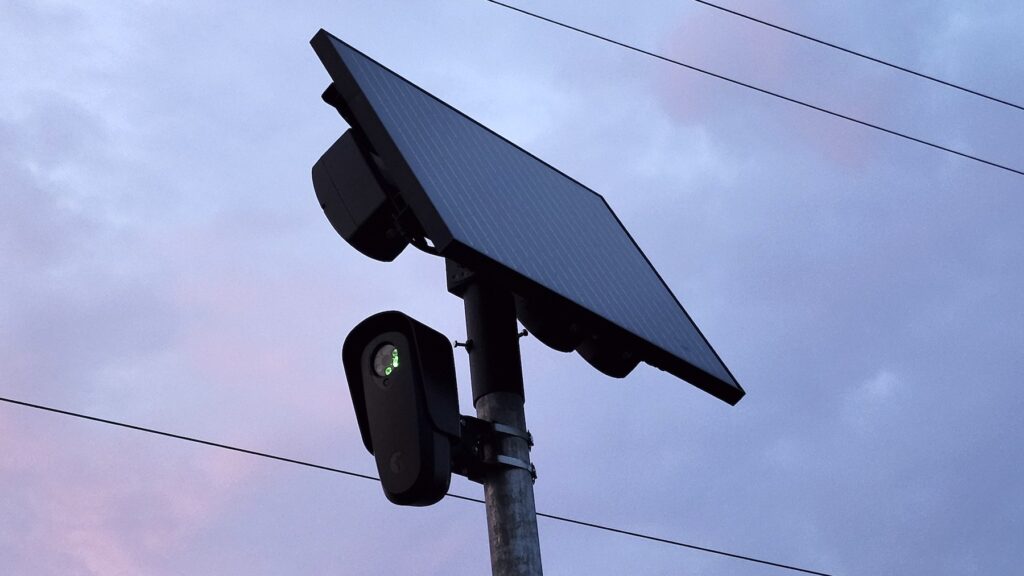
ADRIAN — After several weeks of discussion, Lenawee County commissioners voted on July 9 to approve a proposal to install license plate-reading cameras along some county roads.
The Lenawee County Sheriff’s Office plans to install six stationary cameras and one “Flex” camera that can be easily moved as necessary, for example during Michigan International Speedway race weekends.
The plan calls for six stationary cameras at three points along Ridge Highway in Macon, Ridgeway and Palmyra Townships — with two cameras, one facing each direction, at each location. The seventh would initially be on Deerfield Road. At a previous meeting, Capt. Jake Pifer of the sheriff’s office said that those tend to be the main routes taken in and out of Lenawee County by people who commit crimes.
“Criminals tend to stay off the main highways,” Pifer explained at a June 5 meeting of the criminal justice committee. “There is a notion that police officers are on the main highways. If they commit a higher-level crime, they’re going to drive on the back roads.”
The cameras will be purchased from Flock Safety, which works with about 5,000 communities across the U.S., including the Adrian Police Department.
County commissioners’ debates centered mainly around civil liberties concerns, in particular how long data will be stored. The American Civil Liberties Union and the Electronic Frontier Foundation are among the groups that have urged municipalities not to install license plate readers, or if they do use them, to limit data retention to short periods of time.
Commissioner Kevon Martis (R-Riga), who voted against the proposal, said his reason for opposing it was the 30-day data retention period for plate images.
Commissioner Terry Collins (R-Adrian), who is a retired Adrian police chief, was not at the July 9 meeting but spoke in favor of the cameras at previous meetings.
At the June 5 meeting, Collins said that a shorter retention period — such as 72 hours — would not necessarily be long enough for some crimes. He recalled one kidnapping case he worked on where it took more than three days to get the young victim to open up about what happened and describe the suspect’s car.
At that same meeting, Commissioner Dustin Krasny (R-Onsted) asked about security and whether the devices can be hacked. Jonathan Paz, a representative from Flock, said that no data is stored on the cameras themselves. Instead, the data is wirelessly transmitted with end-to-end encryption, and if somebody stole a camera there wouldn’t be any information on it to access. He said the Flock system has never been hacked.
Sheriff Troy Bevier said he had held back on adopting the system at first, but that his initial concerns have been answered. He also said that cameras on the Flock system have been used to track down suspects in several high-profile crimes in the area, such as a case last year where a Lenawee County shooting suspect was found in Jackson County. The suspect, an Onsted man, led officers on a high-speed chase, shooting at them and tossing pipe bombs from his car, before he was shot and killed by police when the chase ended.
The system takes pictures of license plates as cars pass the cameras, and then if law enforcement officers are looking for a particular car, they can put its plate number into a “hot list.” Flock will then search all cameras across its network for places where that car has been seen.
Sheriff Troy Bevier noted that there is an audit feature that allows a supervisor to see which officer searched for a plate in the system and why.
Flock is also rolling out a feature that allows camera feeds to be viewed live, but Lenawee County’s contract will call for that feature to not be active on the county’s cameras.
“It’s an opt-in feature and we’re not opting in,” Bevier said at a June 24 criminal justice committee meeting.
The final vote to approve the camera proposal was 6-2, with Collins absent.
Voting yes were David Aungst (R-Rollin Twp.), Beth Blanco (R-Clayton), Jim Daly (D-Adrian), David Stimpson (R-Tecumseh), Ralph Tillotson (R-Adrian Twp.), and Jim Van Doren (R-Tipton).
Voting no were Martis and Krasny.
The agreement is for a two-year pilot program at a cost of $55,000.
Previous stories:
