
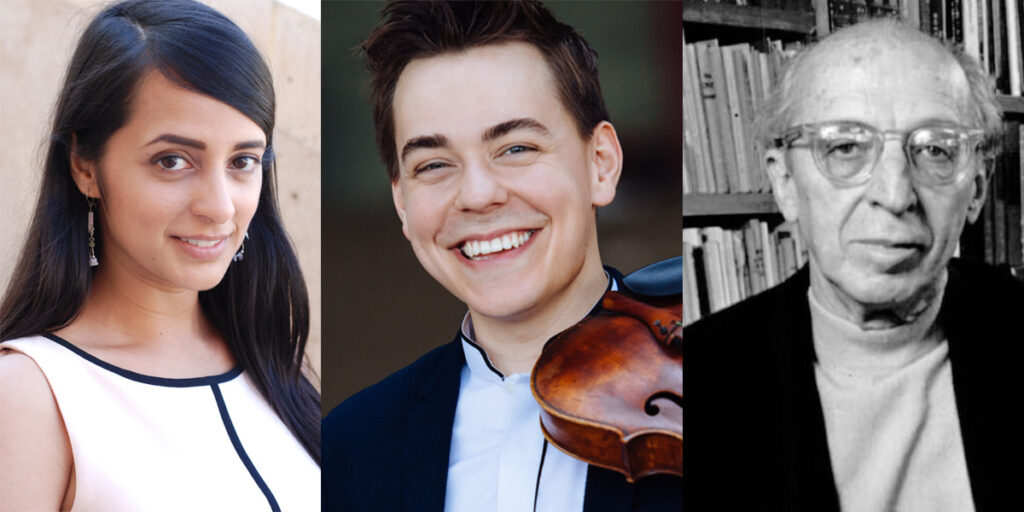
ADRIAN — After a couple of pops-oriented concerts in December and February, the Adrian Symphony returns to its season-long dive into the music of Aaron Copland this month with a concert featuring Copland’s “Appalachian Spring.”
The performance is at 7:30 p.m. Friday, March 14, at Adrian College’s Dawson Auditorium. Tickets are $39/$33/$25, with discounted rates of $37/$31/$25 for senior citizens and $20/$17/$13 for students.
Tickets can be purchased online at www.adriansymphony.org; by calling 517-264-3121; at the ASO office in Mahan Hall, Adrian College, from 9 a.m. to 5 p.m. Mondays through Fridays; or at the door beginning two hours prior to the concert.
A pre-concert Classical Conversation with ASO Music Director Bruce Anthony Kiesling begins at 6:40 p.m. in the auditorium and is free to all ticketholders.
The concert opens with “Vishwas III: Testament,” written in 2017 by Indian-American composer Reena Esmail.
Esmail writes on her website that the Hindi word “vishwas” “expresses the concept of fervent belief, or faith.” “Testament” is the last of three movements in Esmail’s piece, which overall tells the story of a 15th-century Indian saint-poet named Meera Bai and her devotion to the Hindu deity Lord Krishna.
Kiesling first got to know Esmail’s music through a conductor colleague, and found himself really drawn to it.
“What I love about Reena’s work is that she’s finding a way to combine these two very different traditions [Indian and American], and it’s groundbreaking in that she does it so well,” he said.
Kiesling decided a couple of years ago that he wanted to program this piece, and ever since that time “you continue to see Reena’s star really rising. … Her music doesn’t sound like anyone else’s, and I really love that.”
In this piece, the ASO concert audience will get to hear an instrument that’s common to Indian music: a tabla, which is a traditional instrument consisting of two hand drums.
Including the tabla in the full-orchestra version of “Testament,” which is the version the ASO will perform, is optional but recommended by the composer, and “I think it’ll be a really great combination,” Kiesling said.
After this short work, guest artist Matthew Lipman joins the ASO for a performance of John Williams’ Concerto for Viola and Orchestra.
Lipman, a Chicago native who frequently collaborates with some of today’s top classical artists and has premiered a number of works by contemporary composers, performs both as a soloist and with orchestras across the country and around the world.
Kiesling has worked with him previously and finds him to be “really an exceptional artist,” he said. “I was blown away by his artistry and his warmth.”
It was Lipman who suggested performing this particular concerto, and Kiesling was happy to program it because, while people are very familiar with Williams’ many film scores and his music for several Olympic Games, his classical pieces are not that well known and his concertos “haven’t entered the mainstream,” Kiesling said.
And this concerto is even less known than other Williams classical works, because the full version has never been played other than by the Boston Symphony and in fact had not even been published when the ASO programmed it.
Both Kiesling and Lipman worked their contacts to connect with Williams, and the end result was that the publishing company that was planning to publish the music fast-tracked it so it could be performed now.
Williams has a well-deserved reputation as a master mood-creator through his orchestrations, and this work “has that in spades,” Kiesling said. “I think our audience members are going to enjoy it.”
“Appalachian Spring” makes up the concert’s second half. While the piece is best known in one of its suite versions, whether for chamber orchestra or full orchestra, the ASO will perform the full ballet score, as it has also done this season with Copland’s “Billy the Kid” and “Rodeo.”
As with those other two works, Copland wrote “Appalachian Spring” as a ballet for Martha Graham, with whom he collaborated several times. The ballet premiered in 1944, with the score earning Copland the 1945 Pulitzer Prize for Music.
It was Graham who gave the work its name, using the title of a Hart Crane poem. Copland himself simply called it “Ballet for Martha.”
Set in 19th-century Appalachian Pennsylvania, the ballet focuses on four characters: the Bride, the Husbandman, the Pioneer Woman, and the Revivalist, as the Bride and the Husbandman get married and the community celebrates.
As he so often did in his music, Copland makes extensive use of folk tunes in “Appalachian Spring,” most notably the Shaker hymn “Simple Gifts.”
It’s a composition that has long has a special resonance with many listeners, including Kiesling himself. “Something about it just really grabs me spiritually,” he said.
And like Copland’s other ballet scores, “it’s distinctly American. I think we saved the best of his ballets for last.”
‘Appalachian Spring’
- Date and time: Friday, March 14, at 7:30 p.m.
- Location: Dawson Auditorium, Adrian College
- Cost: $39/$33/$25 (discounted rates of $37/$31/$25 for seniors and $20/$17/$13 for students)
- More info: 517-264-3121 or adriansymphony.org
